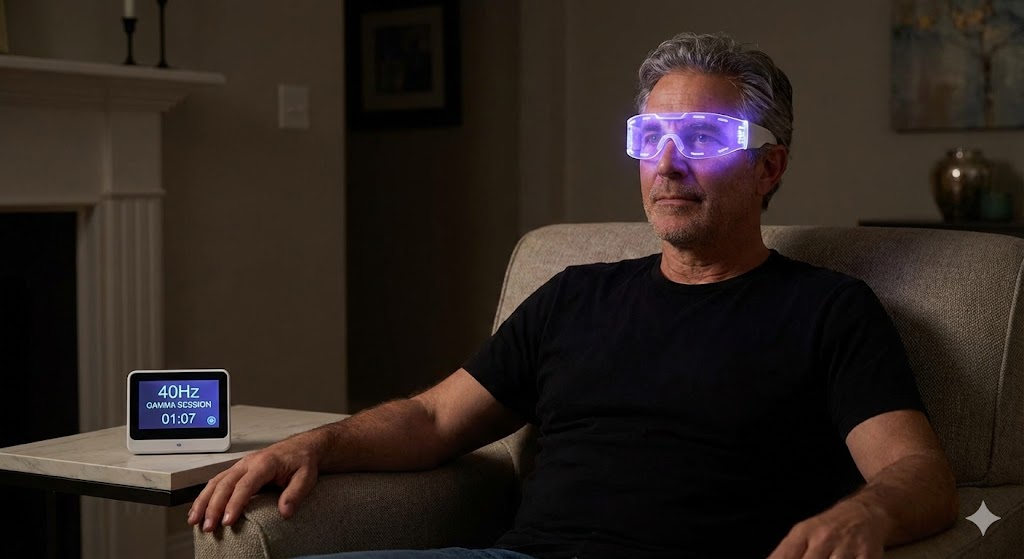
- Safety: 40Hz flickering light can trigger seizures in people with photosensitive epilepsy. If you have a history of seizures or migraines, do not use this therapy without direct neurological supervision.
- Effectiveness: Clinical trials, including those from MIT, show that 40Hz stimulation can reduce amyloid plaque load and improve cognitive scores in Alzheimer’s models. It works by entraining brain waves to the gamma frequency.
- Key Benefit: It activates microglia, the brain’s immune cells, to “eat” toxic proteins and debris, effectively cleaning the neural pathways.
You feel the fog rolling in. Remembering names takes longer. You worry about the long-term health of your brain. Most advice centers on crossword puzzles or fish oil. But there is a non-chemical intervention gaining traction in neurology labs: Light. Specifically, light that flickers 40 times per second.
The brain operates on electricity. Neural networks communicate via rhythmic pulses called brain waves. In neurodegenerative conditions like Alzheimer’s, one specific frequency—Gamma (40Hz)—often weakens or disappears. This loss of rhythm disrupts the brain’s ability to clean itself.
For the efficiency-minded user, the goal is “entrainment.” By exposing the eyes to a 40Hz light source, you force the visual cortex to synchronize with that rhythm. This spreads throughout the brain. Evidence suggests that 40hz light therapy for gamma waves is not just about seeing light; it is about jumpstarting the brain’s janitorial service.
Physiologically Speaking: Microglial Activation
The brain has its own immune system, primarily made of cells called microglia. In a healthy brain, microglia hunt down and consume toxic waste, like amyloid-beta plaques. In a diseased brain, they become sluggish or inflammatory. The 40Hz rhythm acts as a “wake-up call” for these cells.
Physiologically speaking, the gamma oscillation changes the morphology of microglia. They physically expand and become “hungry” again. A landmark study published in Nature demonstrated that this specific frequency reduced amyloid load by over 50% in the visual cortex of mice. It essentially turns the immune system from a passive observer into an active cleaner.
A direct comparison reveals why frequency matters. Random flickering light does nothing. 20Hz light does not trigger the same immune response. Only the precise 40Hz gamma band engages the specific interneurons (parvalbumin-positive) required to synchronize the network and trigger the clean-up crew.
| Feature | 40Hz Gamma Stimulation | Standard Bright Light Therapy |
|---|---|---|
| Primary Mechanism | Neural entrainment & microglial activation. | Circadian rhythm regulation (Melatonin). |
| Target Condition | Cognitive decline & amyloid buildup. | SAD (Seasonal Affective Disorder). |
| The Practical Catch | Requires 1 hour daily exposure. | Only requires 15-30 mins in the morning. |
5 Practical Ways To Integrate Gamma Therapy
1. The “Peripheral” Setup
You do not need to stare directly at the bulb. The effect works through peripheral vision. Place the 40Hz light panel at a 45-degree angle to your face while you read or watch TV. This makes the daily hour-long session sustainable.
Pro-Tip: Ensure the light covers a significant portion of your visual field for maximum entrainment.
2. Auditory Stacking
The brain processes sound and light in different areas, but they can be synchronized. “GENUS” (Gamma Entrainment Using Sensory stimuli) often combines 40Hz light with a 40Hz sound tone. This dual-sensory input engages the auditory cortex and the visual cortex simultaneously, creating a stronger, brain-wide effect.
Pro-Tip: Use noise-canceling headphones to isolate the 40Hz tone.
3. Timing Matters
Gamma waves are associated with high-level cognitive processing and focus. Do not use this therapy before bed, as it can be stimulating. The optimal window is mid-morning or early afternoon when you need peak mental clarity.
Pro-Tip: Session consistency is more important than intensity; do it at the same time every day.
4. Verify The Hardware
Not all “flickering” lights are 40Hz. A standard LED bulb flickers at 60Hz or 120Hz (mains frequency), which is invisible to the eye and biologically irrelevant for this purpose. You must buy a device specifically calibrated and engineered for 40Hz output.
Pro-Tip: Look for “Gamma” or “40Hz” specific branding from reputable medical tech companies.
5. Monitor For Headaches
The flicker is visible and can be annoying or inducing for some. If you get headaches or nausea, start with 15 minutes and slowly titrate up to the full hour over a month. Your brain needs time to adjust to the forced synchronization.
Pro-Tip: If the flicker is too harsh, look for “masked” technology that makes the flicker less perceptible while maintaining the biological effect.
Stacking Your Strategy For Neuroprotection
To make this work 20% better, stack your 40Hz Light Therapy with Lion’s Mane Mushroom.
While the light clears the debris (amyloid), Lion’s Mane stimulates the growth of new connections (neurogenesis) via Nerve Growth Factor (NGF). One cleans the construction site; the other brings in new building materials. Together, they provide a comprehensive protocol for maintaining neural plasticity and structural integrity.
Safety & Precautions
1. Epilepsy Risk
This is the absolute contraindication. Flickering light triggers seizures in photosensitive individuals.
Safety Note: If you have ever had a seizure, do not touch this technology.
2. Migraine Triggers
Stroboscopic effects can instantly trigger a migraine in susceptible people.
Caution: Stop immediately if you feel ocular pain or an aura.
3. Eye Strain
Constant flickering can fatigue the eye muscles.
Heads Up: Follow the “20-20-20 rule” (look at something 20 feet away for 20 seconds every 20 minutes) during your session.
4. Sleep Disruption
Gamma is an “awake” frequency. Using it after 6 PM can ruin your sleep architecture.
Doctor’s Note: Treat it like caffeine; cut it off in the early afternoon.
5. False Hope
This is a therapy, not a cure. It manages symptoms and potentially slows progression.
Warning: Do not stop prescribed Alzheimer’s medications (like Donepezil) without your neurologist’s consent.
5 Common Myths vs. Facts
Myth 1: Any strobe light works.
Fact: Precision is key. 38Hz or 42Hz does not have the same resonance effect on amyloid clearance. It must be strictly 40Hz.
Myth 2: It hurts your eyes.
Fact: At correct intensities, it is safe for the retina. The danger is neurological (seizures), not ophthalmological (blindness).
Myth 3: You feel the “Gamma” instantly.
Fact: You feel nothing. It is a subtle biological process. Cognitive improvements in trials typically took 3 to 6 months to manifest.
Myth 4: It only works for Alzheimer’s.
Fact: Early research suggests potential benefits for stroke recovery and traumatic brain injury, as these also involve inflammation.
Myth 5: Sound is enough.
Fact: Light seems to be more potent for clearing amyloid in the visual cortex, while sound targets the auditory cortex. Combined is best, but light is the primary driver.
The Bottom Line
Rhythm regulates recovery.
My analysis concludes that for the data-driven consumer, 40Hz Light Therapy represents a breakthrough in non-invasive neurology. It leverages the brain’s intrinsic electrical language to trigger a physical cleanup of toxic proteins. It is safe for the non-epileptic majority and offers a proactive tool for brain aging.
The practical catch is the daily time commitment. For a clinical-strength result that actually moves the needle on cognitive clarity, I recommend pivoting to a Dedicated 40Hz Light Panel used for 60 minutes daily during your morning routine. Stack it with Lion’s Mane to ensure that as you clear the old pathways, you are actively building new ones.
Get Your FREE Ultimate Vitamin Guide!
Join the VitaminProGuide community to receive science-backed supplement reviews, nutritional insights, and absorption tips, delivered straight to your inbox.