- Safety: Magnesium is cleared by the kidneys. If you have chronic kidney disease (CKD), do not supplement without a nephrologist’s approval. Threonate is generally well-tolerated but starts at a lower elemental dose.
- Effectiveness: Clinical data suggests Magnesium L-Threonate is the only form proven to significantly increase magnesium levels in the cerebrospinal fluid. Glycinate excels at physical relaxation due to the glycine content.
- Key Benefit: Threonate turns off the “racing thoughts.” Glycinate relaxes the “restless body.”
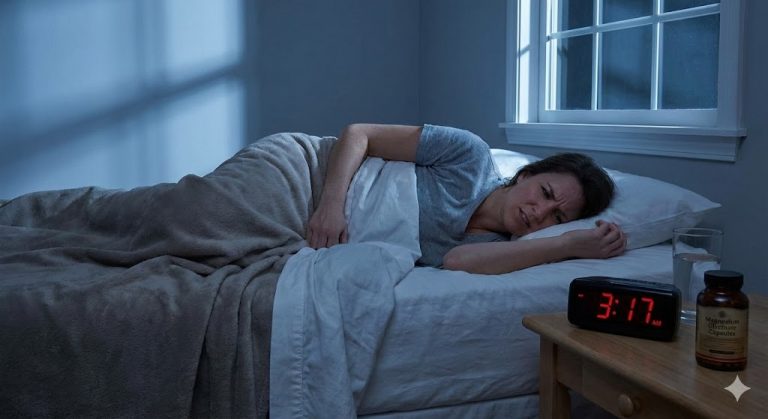
You are exhausted. Your body is heavy. But the moment your head hits the pillow, your brain decides it is time to review every mistake you made since 2010. This is “tired but wired.” It is the hallmark of sleep anxiety.
Most people treat this with Melatonin. But Melatonin only signals when to sleep. It does not turn off the stress engine. To actually silence the noise, you need to lower the brain’s excitability. Magnesium is the master mineral for this. But not all magnesium can get into the command center.
A closer look at blood-brain barrier transport rates reveals a distinct divide between these two popular forms. While both address deficiency, only one effectively crosses the protective lipid membrane to directly calm the firing neurons. The battle of Magnesium Threonate vs Glycinate for sleep anxiety isn’t about which is “stronger.” It is about where the tension lives. In your muscles. Or in your mind.
Decoding Magnesium Transport Across The Brain Barrier
Your brain is protected by a fortress called the Blood-Brain Barrier (BBB). It keeps toxins out. Unfortunately, it also keeps most mineral supplements out. Standard magnesium (like Oxide or Citrate) raises blood levels effectively. But it struggles to cross into the brain tissue where the anxiety loops are firing.
According to research published by the National Institutes of Health (NIH), Magnesium L-Threonate was engineered specifically to solve this problem. It uses the threonic acid metabolite to carry magnesium across the lipid membrane of the brain. Once inside, it binds to NMDA receptors. It acts as a brake on the “fear memory” pathways that keep you awake.
Magnesium Glycinate works differently. It dissociates into magnesium and glycine in the gut. Glycine is an inhibitory neurotransmitter. It lowers core body temperature and promotes physical muscle relaxation. It calms the hardware (body), while Threonate calms the software (mind).
| Feature | Magnesium L-Threonate (Magtein) | Magnesium Glycinate (Bisglycinate) |
|---|---|---|
| Primary Mechanism | Crosses Blood-Brain Barrier to block glutamate. | Increases systemic glycine to relax muscles. |
| Direct Benefit | Stops racing thoughts and improves memory. | Relieves physical tension and lowers body temp. |
| The Practical Catch | Expensive and contains less elemental magnesium. | Does not penetrate brain tissue as efficiently. |
5 Strategic Ways To Choose The Right Sedative
1. The “Racing Mind” Diagnostic
If your main sleep issue is ruminating thoughts, worry loops, or mental chatter, Threonate is your tool. It targets the prefrontal cortex and hippocampus. It helps extinguish the “fear conditioning” that makes you anxious about not sleeping.
Pro-Tip: You need 2,000mg of Magtein (providing 144mg elemental Mg) to hit the clinical dose.
2. The “Restless Body” Protocol
If you toss and turn, have twitchy legs, or carry tension in your shoulders, Glycinate is superior. The glycine acts as a natural muscle relaxant. It also helps drop your body temperature, which is a biological trigger for deep sleep.
Pro-Tip: Take 400mg of Magnesium Glycinate 1 hour before bed.
3. The Price-Per-Sleep Factor
Magnesium L-Threonate is a patented compound (Magtein). It is expensive. Often $40-$60 a bottle. Glycinate is affordable and widely available. If budget is a constraint, start with Glycinate.
Pro-Tip: If Glycinate fails to stop the mental noise, then invest in Threonate.
4. Daytime vs. Nighttime
Threonate is unique because it improves cognitive focus during the day while helping sleep at night. It optimizes brain function. Glycinate is purely a relaxant. It is best reserved for the evening.
Pro-Tip: You can take a small dose of Threonate in the morning for clarity without drowsiness.
5. Digestive Tolerance
Both forms are gentle on the stomach compared to Oxide or Citrate. However, Glycinate is generally the most tolerated form for sensitive guts. Threonate can cause mild headaches in the first week as brain levels adjust.
Pro-Tip: Start with half the recommended dose of Threonate to avoid the “head rush.”
Stacking Your Strategy For Maximum Bioavailability
To make this work 20% better, combine Magnesium Glycinate with L-Theanine. This creates a “Body + Mind” sedative stack without the cost of Threonate.
The Glycinate relaxes the muscles. The L-Theanine (an amino acid from green tea) increases Alpha brain waves to calm the mind. While it doesn’t have the same neuroplasticity benefits as Threonate, it effectively mimics the “quieting” effect for a fraction of the price. Take 400mg Glycinate + 200mg L-Theanine 60 minutes before sleep.
Safety & Precautions
1. Kidney Clearance
Your kidneys filter excess magnesium. If they are compromised, magnesium toxicity can occur. This leads to low blood pressure and cardiac arrest.
Safety Note: Always check your eGFR (kidney function) before starting high-dose minerals.
2. Blood Pressure Drop
Magnesium relaxes blood vessels. This lowers blood pressure. If you are already on hypotension medication, this can make you dizzy.
Caution: Monitor your BP if you take beta-blockers.
3. The “Paradoxical Effect”
A small percentage of people find Glycinate stimulating. This is due to how their brain processes glutamate/glycine.
Heads Up: If Glycinate keeps you awake, switch to Magnesium Malate or Threonate.
4. Antibiotic Interaction
Magnesium binds to tetracycline antibiotics in the gut. This stops the drug from working.
Doctor’s Note: Separate the supplement and the antibiotic by at least 4 hours.
5. Withdrawal
There is no chemical dependency. However, if you stop taking it, your original magnesium deficiency symptoms (anxiety/insomnia) will return.
Warning: Consistency is key. It is a nutrient, not a drug.
5 Common Myths vs. Facts
Myth 1: All magnesium makes you sleepy.
Fact: Magnesium Malate (bound to malic acid) is actually energizing and used for fatigue. Only Glycinate and Threonate support sleep.
Myth 2: Threonate is synthetic.
Fact: It is a chelated salt of magnesium and a Vitamin C metabolite. It is engineered, but the components are natural.
Myth 3: You can test magnesium with a standard blood test.
Fact: Serum magnesium tests are useless. Only 1% of magnesium is in the blood. You need an RBC (Red Blood Cell) Magnesium test.
Myth 4: ZMA is the best for sleep.
Fact: ZMA usually contains Magnesium Aspartate. This is decent, but Glycinate has better relaxation data.
Myth 5: It works immediately.
Fact: It takes time to replenish cellular magnesium levels. Give it at least 2 weeks of nightly use.
The Bottom Line
Sleep anxiety is a biological short-circuit.
Based on the research, I believe that for the Skeptical Optimizer, the choice is specific to your symptoms. If your body is tired but your mind is racing, Magnesium L-Threonate is the investment you need to make. It is the only form that reliably penetrates the brain to turn off the chatter.
While chamomile tea is a nice ritual, the practical gap is that it lacks the potency to alter neurotransmitter firing rates. For a clinical-strength result that physically relaxes you, I recommend pivoting to Magnesium Glycinate as your daily foundation. If that isn’t enough to silence the thoughts, upgrade to the Threonate. Get the mineral into the right tissue.
Get Your FREE Ultimate Vitamin Guide!
Join the VitaminProGuide community to receive science-backed supplement reviews, nutritional insights, and absorption tips, delivered straight to your inbox.