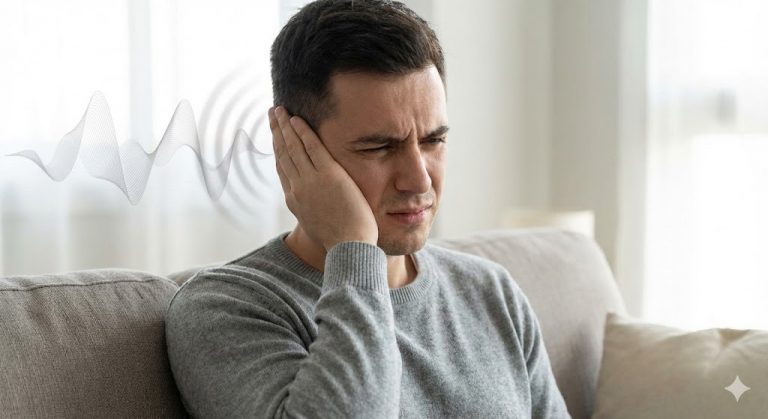
- Safety: Pulsatile tinnitus is a “red flag” symptom because it is objective (a doctor can sometimes hear it). It often signals a vascular issue like an aneurysm or high blood pressure. Unlike standard ringing, it requires immediate medical imaging (MRA/MRV).
- Effectiveness: Treating pulsatile tinnitus involves fixing the underlying mechanical cause (e.g., stenting a narrowed vein or managing hypertension), which has a much higher cure rate than subjective tinnitus treatments.
- Key Benefit: Identifying the “whoosh” sound early can prevent stroke or vision loss associated with conditions like Idiopathic Intracranial Hypertension (IIH).
You hear a sound in your ear. It isn’t a high-pitched whine. It is a rhythmic whoosh, whoosh, whoosh that matches your heartbeat. This is not standard tinnitus. It is Pulsatile Tinnitus. While annoying, the standard ringing is usually a software glitch in the brain. Pulsatile tinnitus is a hardware problem in the blood vessels.
Most people assume all ear noise is hearing damage. This is a dangerous oversimplification. If the sound has a tempo, it means you are hearing the turbulence of your own blood flow. Something is causing the blood to swirl or rush near the auditory nerve.
For the data-focused consumer, the distinction is key. I looked into the blood flow-related causes of hearing issues. Evidence suggests that the causes of pulsatile tinnitus vs ringing are structural rather than neurological. One is a phantom sound; the other is a physical vibration.
Physiologically Speaking: Turbulence vs. Phantom Noise
Standard tinnitus (subjective) is caused by the death of hair cells in the cochlea. The brain, missing the input, “turns up the volume” to compensate, creating a static hiss. It is a sensorineural issue.
Physiologically speaking, Pulsatile Tinnitus (objective) is mechanical. It is caused by increased blood flow or turbulent flow in the arteries or veins near the ear. This can be due to a kink in the vessel, a narrowing (stenosis), or a thinning of the bone that separates the ear from the carotid artery.
A direct comparison reveals the urgency gap. Subjective ringing is annoying but rarely life-threatening. Pulsatile tinnitus can be a warning sign of a dural arteriovenous fistula (dAVF) or severe atherosclerosis. A study in the American Journal of Otolaryngology found that up to 70% of pulsatile tinnitus cases have an identifiable, treatable vascular cause.
| Feature | Pulsatile Tinnitus (Vascular) | Subjective Tinnitus (Neurological) |
|---|---|---|
| Sound Quality | Rhythmic thumping/whooshing. | Steady ringing, buzzing, or hiss. |
| Primary Cause | Turbulent blood flow (Hardware). | Hearing loss/Brain activity (Software). |
| The Practical Catch | Requires imaging (MRI/CT). | Diagnosis of exclusion; harder to cure. |
5 Clinical Signs It’s Vascular
1. The Neck Compression Test
Gently press on the jugular vein on the side of the noise. If the sound stops or changes, it is likely venous in origin. This is a common sign of venous sinus stenosis or a high-riding jugular bulb.
Pro-Tip: Do not press both sides at once; you might faint.
2. Exercise Amplification
Does the sound get louder when you run or climb stairs? If increasing your heart rate increases the volume of the noise, it is directly tied to cardiac output. Standard ringing usually doesn’t change instantly with pulse rate.
Pro-Tip: Check your blood pressure immediately after exercise to see if hypertension is the trigger.
3. The “Head Turn” Effect
Turn your head fully to the left or right. If the sound disappears, you may be kinking a specific vessel (like the internal jugular vein) against a bone spur (Eagle Syndrome) or muscle. This mechanical modulation confirms a structural cause.
Pro-Tip: Note exactly which position stops the noise to tell your doctor.
4. Intracranial Pressure Signs
If you have pulsatile tinnitus and frequent headaches or vision issues (blurriness), you might have Idiopathic Intracranial Hypertension (IIH). The high pressure in the skull compresses the veins, causing the “whooshing” sound.
Pro-Tip: See an ophthalmologist to check for papilledema (swollen optic nerve).
5. Unilateral Occurrence
While ringing can be in both ears, pulsatile tinnitus is almost always in just one ear. This points to a specific vascular abnormality on that side, rather than a systemic issue like general hearing loss.
Pro-Tip: If it’s in both ears, check for systemic anemia or thyroid issues first.
Stacking Your Strategy For Diagnosis
To make this work 20% better, stack your Doctor’s Visit with a request for an MRA and MRV.
A standard MRI often misses the blood vessels. You need a Magnetic Resonance Angiography (MRA) to see the arteries and a Magnetic Resonance Venography (MRV) to see the veins. These specific scans visualize the flow and can detect the fistulas or stenoses that cause the noise. Without the “A” and “V,” you are only seeing half the picture.
Safety & Precautions
1. Stroke Risk
Sudden onset of whooshing can be a sign of carotid artery dissection.
Safety Note: If accompanied by neck pain or droopy eye, go to the ER immediately.
2. Anemia Check
Thin blood moves faster and more turbulently.
Caution: Before panicking about tumors, get a simple CBC blood test to rule out severe iron deficiency.
3. Thyroid Storm
Hyperthyroidism increases cardiac output and blood flow velocity.
Heads Up: If you have anxiety and tremors with the noise, check your TSH levels.
4. Don’t Ignore It
Unlike ringing, you cannot just “get used to” pulsatile tinnitus without ruling out physical causes.
Doctor’s Note: It is a symptom that demands investigation, not just acceptance.
5. Noise Exposure
While less relevant for pulsatile, loud noise can worsen the perception of it by damaging the hearing nerve.
Warning: Protect your ears even if the cause is vascular.
5 Common Myths vs. Facts
Myth 1: It’s just aging.
Fact: While atherosclerosis increases with age, pulsatile tinnitus in a young person is often IIH or a venous anomaly. It is not a normal part of aging.
Myth 2: Earwax causes it.
Fact: Earwax can cause conductive hearing loss (making internal sounds louder), but it rarely causes a rhythmic, pulse-synced whoosh on its own.
Myth 3: There is no cure.
Fact: This is true for ringing, but false for pulsatile. If the cause is a narrowed vein, a stent can cure it instantly. It has a high rate of treatability.
Myth 4: It’s high blood pressure.
Fact: Hypertension can make it louder, but it is rarely the sole cause. Usually, there is a structural narrowing that becomes audible only when pressure rises.
Myth 5: White noise masks it.
Fact: White noise masks high-pitched ringing. Pulsatile tinnitus is often low-frequency and thumping, which cuts through white noise. Pink or Brown noise works better.
The Bottom Line
Rhythm requires a reason.
My analysis concludes that for the efficiency-minded patient, distinguishing Pulsatile Tinnitus from standard ringing is the most important diagnostic step you can take. If it has a beat, it has a cause. It is a hydraulic issue, not just a hearing issue.
The tricky part is the testing. You need to push for the right scans. For a solid, clinical-level result that brings peace of mind, consider switching to a Neuro-Otologist referral. Pair it with a Neck Compression Test at home so you can show up to the appointment with data in hand, not just a list of symptoms.
Get Your FREE Ultimate Vitamin Guide!
Join the VitaminProGuide community to receive science-backed supplement reviews, nutritional insights, and absorption tips, delivered straight to your inbox.