- Safety: Blocking all blue light during the day can cause depression and fatigue. The goal is to maximize blue light in the morning (for cortisol) and eliminate it at night (for melatonin), not to live in darkness.
- Effectiveness: Research shows that even 30 lux of blue light (a single LED bulb) suppresses melatonin by 50%. The specific wavelength of 460-480nm is the primary trigger for this suppression.
- Key Benefit: Avoiding blue light 2 hours before bed allows your pineal gland to naturally secrete maximal melatonin, improving sleep onset latency and deep sleep duration without supplements.
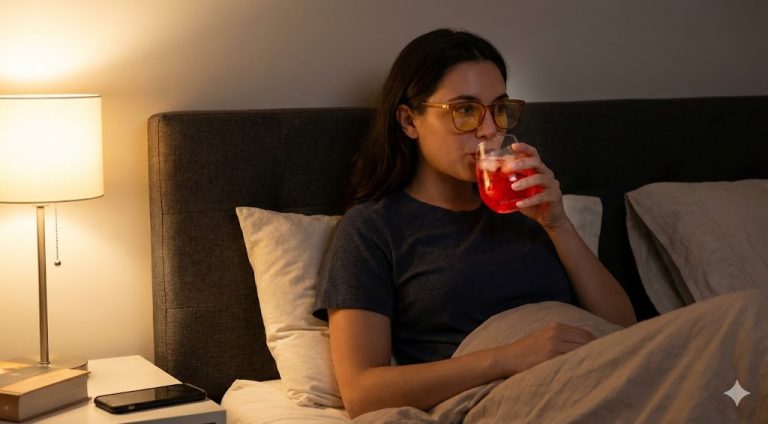
You lie in bed scrolling through your phone. Your body is tired, but your brain feels “wired.” This is not an accident. Your phone screen is broadcasting a signal directly into your eyes that tells your brain it is noon. You are chemically cancelling your sleep.
Melatonin is the “hormone of darkness.” It is only produced when specific sensors in your eyes detect the absence of short-wavelength light. Modern LED screens emit a massive spike of this exact wavelength. It is a biological mismatch. We are nocturnal scrollers in a diurnal body.
I analyzed the spectral sensitivity of retinal ganglion cells. Evidence suggests that how does blue light inhibit melatonin production is a direct neural pathway inhibition. It stops the signal from the master clock to the melatonin factory.
Physiologically Speaking: The Melanopsin Trigger
Your eyes have rods and cones for vision. But they also have a third type of sensor called Intrinsically Photosensitive Retinal Ganglion Cells (ipRGCs). These cells do not “see” images. They measure brightness. They contain a photopigment called melanopsin.
Physiologically speaking, melanopsin is uniquely sensitive to blue light (around 480nm). When blue light hits these cells, they send an electrical signal to the Suprachiasmatic Nucleus (SCN), the brain’s master clock. The SCN then sends an “inhibitory” signal to the pineal gland. This stops melatonin synthesis instantly.
A direct comparison reveals the potency. Red light does not trigger melanopsin. You can sleep under red light. Blue light is a “wake-up drug.” A study in the Journal of Clinical Endocrinology & Metabolism found that exposure to room light before bedtime shortened melatonin duration by about 90 minutes. You are literally deleting sleep.
| Feature | Blue Light (460-480nm) | Red/Amber Light (600nm+) |
|---|---|---|
| Target Receptor | Melanopsin (ipRGCs). | Rods/Cones (Vision only). |
| Effect on Pineal Gland | Strong Inhibition (Stop Melatonin). | Neutral (No effect). |
| The Practical Catch | Found in all screens/LEDs. | Hard to work/read under. |
5 Clinical Methods To Protect Melatonin
1. The “Sunset” Rule
Your phone has a “Night Shift” mode. It is weak. It turns the screen slightly orange but still emits significant blue light. You need to stop looking at the screen entirely 2 hours before bed. If you must use screens, install software like f.lux or Iris set to “darkroom” mode (pure red).
Pro-Tip: Turn your iPhone screen to “Red Tint” via Accessibility shortcuts.
2. Amber Glasses (Blue Blockers)
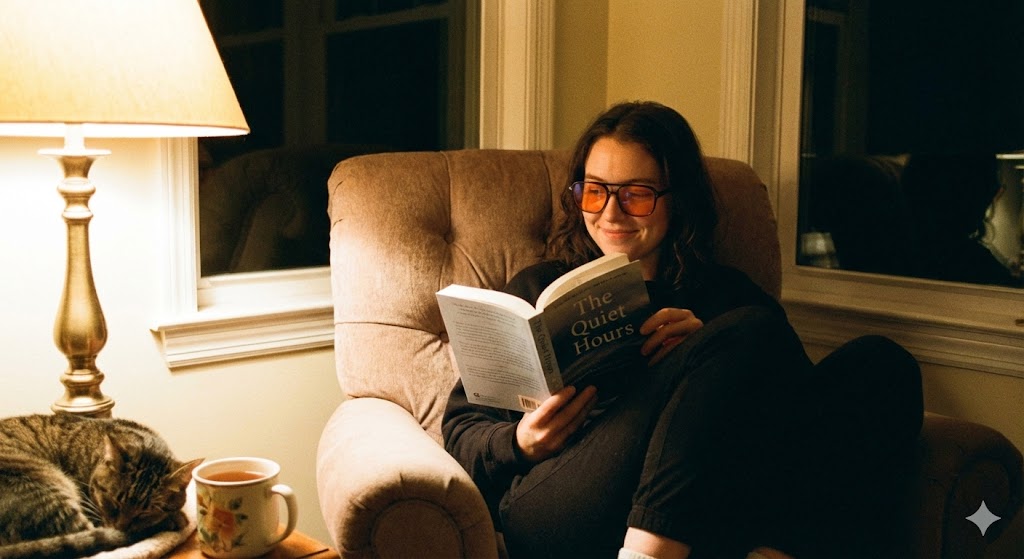
Clear “computer glasses” block 20% of blue light. This is useless for sleep. You need deep amber or red lenses that block 95-100% of the spectrum between 400-500nm. Put them on when the sun goes down. They manually filter the signal before it hits your retina.
Pro-Tip: Look for spectral transmission reports; if they don’t show the graph, don’t buy them.
3. Smart Lighting Audit
Most home LEDs are 5000K (Daylight) or 3000K (Soft White). Both contain blue spikes. Switch your bedroom bulbs to “Smart Bulbs” that can turn pure red or use vintage incandescent bulbs with a warm 2000K filament. Red light does not suppress melatonin.
Pro-Tip: Use low-wattage red nightlights in the bathroom so you don’t wake up fully if you pee at night.
4. Morning Light Anchor
To make melatonin production robust at night, you need a strong cortisol spike in the morning. View bright sunlight (10,000+ lux) for 10 minutes within an hour of waking. This sets the timer. The stronger the morning signal, the stronger the evening release.
Pro-Tip: Do this without sunglasses; the light needs to hit the naked eye.
5. The “Blackout” Environment
Even a streetlamp outside your window can suppress melatonin. Use blackout curtains. Cover the tiny LEDs on your TV or smoke detector with black tape. Your skin also has photoreceptors (though less sensitive). Sleep in total darkness.
Pro-Tip: Use a high-quality sleep mask if you can’t control the room light.
Stacking Your Strategy For Sleep Onset
To make this work 20% better, stack your Blue Light Blocking with Magnesium Glycinate.
Blocking light allows the signal to happen. Magnesium provides the relaxation to act on it. While the darkness tells the brain “it is night,” Magnesium calms the nervous system (lowering glutamate). This combination aligns both the circadian rhythm and the neurotransmitter balance for effortless sleep onset.
Safety & Precautions
1. Seasonal Affective Disorder (SAD)
Blocking blue light during the day can cause depression.
Safety Note: Get plenty of blue light (sun/lightbox) before noon to keep mood elevated.
2. Driving Hazard
Dark amber glasses reduce visibility.
Caution: Do not wear deep sleep glasses while driving at night.
3. False Security
Wearing glasses doesn’t mean you can doom-scroll until 2 AM.
Heads Up: The mental stimulation of social media keeps you awake even if the light is blocked.
4. Vitamin D Myth
Indoor light (even blue) does not make Vitamin D.
Doctor’s Note: You need UV-B (sunlight) for D, not just brightness.
5. Adaptation Period
Wearing red glasses makes colors look weird.
Warning: Your brain adjusts in 10 minutes; don’t take them off or you reset the adaptation.
5 Common Myths vs. Facts
Myth 1: “Night Mode” on phones is enough.
Fact: It reduces blue light by maybe 30-40%. It is not enough to prevent melatonin suppression completely. You need physical filtration or abstinence.
Myth 2: Blue light damages your eyes instantly.
Fact: It causes digital eye strain. The link to permanent macular degeneration is debated, but the link to sleep disruption is definitive fact.
Myth 3: You can take a melatonin pill to counter the phone.
Fact: Exogenous melatonin helps, but the blue light is still stimulating the “wake” centers of the brain (alertness), fighting the pill.
Myth 4: Candlelight suppresses melatonin.
Fact: Candlelight is very low lux and mostly red/infrared. It is the safest light for the evening.
Myth 5: It only matters right before sleep.
Fact: The suppression starts hours before. You need a “dimming down” period starting at sunset to mimic nature.
The Bottom Line
Light is a drug.
My analysis concludes that for the efficiency-minded user, managing Blue Light is the single most effective non-pharmaceutical intervention for sleep quality. It is about respecting your biology. You cannot trick a system that has evolved over millions of years to track the sun.
The tricky part is the inconvenience. We’re hooked on our screens. For a strong, sleep-restoring effect, try getting a pair of Uvex Skyper or similar verified blue-blocking glasses. Slip them on at 8 PM, pair them with some morning sunlight to set your rhythm, and watch your sleep troubles drift away.
Get Your FREE Ultimate Vitamin Guide!
Join the VitaminProGuide community to receive science-backed supplement reviews, nutritional insights, and absorption tips, delivered straight to your inbox.