- Safety: “Fungal acne” (Malassezia folliculitis) looks exactly like clogged pores but worsens with traditional acne treatments (antibiotics). If your bumps itch, avoid oils and heavy creams immediately.
- Effectiveness: Textured skin is usually a buildup of dead cells (hyperkeratosis) or trapped sebum (closed comedones). Chemical exfoliation with AHAs or BHAs is clinically superior to physical scrubs for dissolving these bonds without tearing the skin.
- Key Benefit: Smoothing forehead texture improves light reflection, making skin look instantly younger and allowing makeup to sit flawlessly rather than emphasizing the bumps.
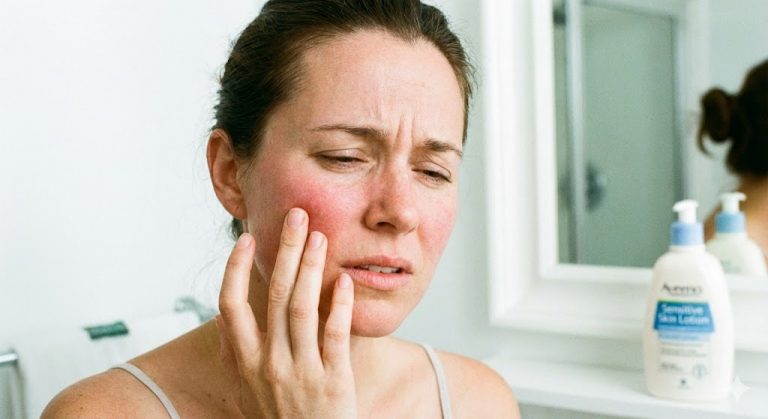
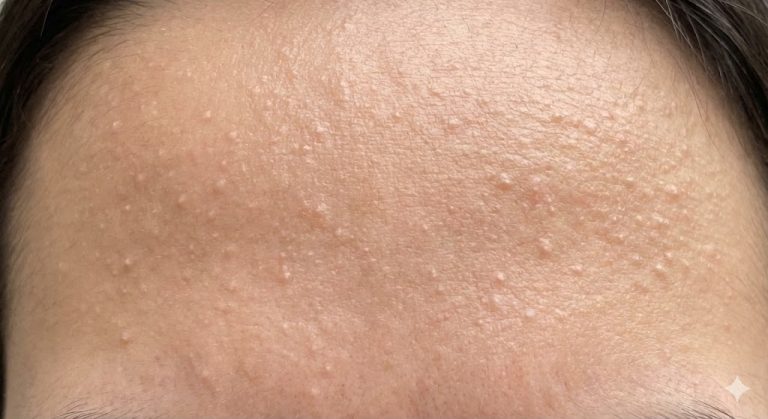
You look in the mirror. From a distance, your skin looks fine. But up close, in the harsh bathroom light, your forehead looks like pebbled leather. Tiny, colorless bumps cover the surface. Makeup just highlights them.
This is “texture.” It isn’t a pimple you can pop. It is a traffic jam. Your skin cells are not shedding correctly. They are sticking together, trapping oil underneath and creating a rough, uneven landscape.
The solution involves both enzymatic and chemical methods. I explored the process of desquamation, or skin shedding, and found that improving textured skin on the forehead requires a careful balance of breaking down the “glue” that binds dead cells together and controlling the oil production that contributes to bumps.
Physiologically Speaking: The Glue Dissolver
Your skin sheds millions of cells a day. Ideally, they fall off invisibly. In textured skin, the “intercellular cement” (glue) holding them together is too sticky. The cells pile up. This is hyperkeratosis.
Physiologically speaking, physical scrubs (apricot pits) only tear the surface. They do not dissolve the glue. Alpha Hydroxy Acids (AHAs) like Glycolic Acid work by chemically loosening the ionic bonds between cells. This forces the skin to shed the rough top layer, revealing the smooth, hydrated cells underneath.
A direct comparison reveals the tool for the job. If the bumps are “surface roughness,” AHAs are best. If the bumps are “deep clogs” (comedones), Beta Hydroxy Acid (Salicylic Acid) is required because it is oil-soluble and can penetrate the pore lining. A study in the Journal of Cosmetic Dermatology demonstrated that a combination peel significantly reduced skin roughness and pore size compared to single-acid treatments.
| Feature | Physical Scrub (Scrub) | Chemical Exfoliant (Acid) |
|---|---|---|
| Mechanism | Friction/Abrasion. | Bond Dissolution. |
| Depth | Surface only. | Surface and Pore (BHA). |
| The Practical Catch | Micro-tears/Irritation. | Sun sensitivity. |
5 Clinical Methods To Resurface The Forehead
1. The Glycolic Acid Toner
Glycolic acid has the smallest molecular size of all AHAs. It penetrates fast. Swipe a 7% Glycolic Acid toner over your forehead every evening. It eats away the dead cell buildup layer by layer. You will see a “glass skin” effect within 2 weeks.
Pro-Tip: It will tingle. If it burns, rinse it off and switch to Lactic Acid (gentler).
2. Double Cleansing Protocol
Texture is often solidified oil and silicone from makeup/sunscreen. A water-based cleanser can’t move it. Use an oil balm first to melt the debris, then a water-based cleanser to wash it away. This “degreases” the canvas, preventing new bumps.
Pro-Tip: Massage the oil cleanser for a full 60 seconds to dislodge “grits” (hardened sebum).
3. Retinoid Introduction
Retinoids speed up cell turnover. They force the skin to make new cells faster, pushing the old, textured cells off. Start with an over-the-counter Adapalene (Differin) gel twice a week. It smooths texture and prevents future clogging simultaneously.
Pro-Tip: Do not use acids and retinoids on the same night; alternate them.
4. Niacinamide Regulation
Large pores contribute to texture. Niacinamide (Vitamin B3) tightens pore laxity and regulates sebum. A 10% serum strengthens the skin barrier, making it smoother and more resilient to texture-causing inflammation.
Pro-Tip: Mix a few drops into your moisturizer to buffer the concentration.
5. The “Fungal” Check
If the bumps are uniform, itchy, and don’t respond to acne meds, it might be yeast (fungal acne). Try washing your forehead with Nizoral (ketoconazole shampoo) as a mask for 5 minutes. If it clears up in 3 days, it was fungus, not dead skin.
Pro-Tip: Fungal acne feeds on fatty acids; switch to an oil-free moisturizer.
Stacking Your Strategy For Polish
To make this work 20% better, stack your Chemical Exfoliant with Hyaluronic Acid.
Exfoliation strips moisture. Dehydrated skin looks more textured (like a dried apple vs. a fresh one). Hyaluronic Acid plumps the cells with water. By applying HA immediately after exfoliating (while skin is damp), you re-inflate the cells, making the surface look instantly smoother and “bouncy.”
Safety & Precautions
1. Over-Exfoliation
If your forehead gets shiny but tight (“plastic wrap” look), you have destroyed your moisture barrier.
Safety Note: Stop all acids immediately. Focus on hydration (ceramides) for 2 weeks.
2. Sun Sensitivity
AHAs make you 50% more susceptible to sunburn.
Caution: You MUST wear SPF 30+ daily, or the sun damage will create worse texture long-term.
3. The “Purge”
Retinoids and acids can cause a temporary breakout as they push gunk to the surface.
Heads Up: This lasts 2-4 weeks. Push through; it means the product is working.
4. Hair Product Transfer
Pomades and oils in your bangs can clog your forehead (Pomade Acne).
Doctor’s Note: Keep hair off your face at night and wash bangs frequently.
5. Waxing Warning
Do not wax your eyebrows while using Retinoids or AHAs.
Warning: The wax will rip off your skin. Stop actives 7 days before waxing.
5 Common Myths vs. Facts
Myth 1: Scrubs are the best way to smooth skin.
Fact: Scrubs are too uneven. They scratch healthy skin and miss the microscopic glue. Chemical exfoliants provide an even, uniform resurfacing.
Myth 2: Pores can open and close.
Fact: Pores do not have muscles. They cannot close. They can only stretch (when full) and shrink (when empty). Cleaning them out makes them appear smaller.
Myth 3: Coconut oil helps texture.
Fact: Coconut oil is highly comedogenic (pore-clogging). It often causes the very texture you are trying to cure. Use Jojoba or Squalane instead.
Myth 4: You can shrink pores permanently.
Fact: Pore size is genetic. You can minimize their appearance by keeping them clear, but you cannot change your DNA.
Myth 5: It happens overnight.
Fact: It takes roughly 28 days for skin to turnover. You need consistent treatment for at least one cycle to see true textural changes.
The Bottom Line
Dissolve, don’t scrub.
My analysis concludes that for the efficiency-minded user, Forehead Texture is a congestion issue. Your skin needs help letting go of the past (dead cells). You must chemically instruct it to shed.
Resist the urge to scrub it away. For a professional-level smoothness on your forehead, switch to using a Glycolic Acid Toner three nights a week. On alternate nights, pair it with a Retinoid to boost cell turnover, leaving those bumps with nowhere to hide.
Get Your FREE Ultimate Vitamin Guide!
Join the VitaminProGuide community to receive science-backed supplement reviews, nutritional insights, and absorption tips, delivered straight to your inbox.