- Safety: Topical solutions are significantly safer for seniors than oral pills due to the lack of drug interactions.
- Effectiveness: Cure rates are lower in older adults due to slower nail growth, often requiring 12 months of consistent therapy.
- Key Benefit: Reducing nail thickness improves walking comfort and prevents secondary bacterial infections.
You look down at your feet and see thick yellowed nails that seem to have become unmanageable overnight. This common scenario leads many older adults to hunt for the best toenail fungus treatment for seniors that won’t interfere with their daily medications. It is a stubborn condition that gets harder to fight as we age.
I refused to accept that dangerous liver-taxing pills were the only solution for clear nails. My investigation into geriatric podiatry revealed that the “standard” treatments often used for younger adults can be risky for seniors on multiple prescriptions. The biology of an aging nail requires a different, gentler approach.
I dug into the clinical trials and dermatology guidelines to find options that balance efficacy with safety. The data shows that while older nails grow slower, making treatment take longer, there are highly effective protocols that do not put your internal organs at risk. It is about patience and choosing the right vehicle for the medicine.
Finding a treatment that penetrates the hard nail plate without entering the bloodstream is the holy grail for senior care. Let us explore the medical and natural options that actually deliver results. Here is how to reclaim your foot health safely.
What the Research Says About Senior Nail Care
My review of the medical literature highlights a critical challenge: as we age, our nails grow roughly 0.5% slower per year, and blood flow to the feet decreases. This means oral medications take longer to reach the site of infection, and the fungus has more time to entrench itself. For seniors, the “best” treatment is often defined by safety profile rather than just raw speed.
I found that the American Academy of Dermatology emphasizes that oral antifungals, while effective, carry risks of liver damage and drug interactions. For a senior taking statins or beta-blockers, adding a systemic antifungal can be dangerous. This is why newer topical agents that penetrate the nail bed are gaining favor in geriatric medicine.
The evidence suggests that a “combination approach”, mechanically thinning the nail followed by topical application, yields the best outcomes for older patients. It turns out that simply painting medicine on a thick, calcified nail is a waste of time and money.
| Feature | Oral Terbinafine (Lamisil) | Topical Efinaconazole (Jublia) | Laser Therapy |
|---|---|---|---|
| Systemic Absorption | High (Enters bloodstream) | Negligible (Local only) | None (Light energy) |
| Liver Risk | Requires liver enzyme monitoring | No known liver risks | No side effects |
| Drug Interactions | High risk with other meds | Safe with other meds | Safe with other meds |
Effective Ways to Treat Stubborn Fungus
1. Prescription Topical Solutions (Efinaconazole)
Unlike older lacquers that required filing, newer prescription solutions like Efinaconazole are designed to penetrate through the nail plate to the bed. I found this to be the safest effective option for seniors because it has almost zero systemic absorption. It requires patience, often needing 48 weeks of daily application.
2. Professional Debridement
This is not a cure, but it is a critical first step. A podiatrist uses a medical-grade burr to grind down the thickened nail plate. My research shows this immediately reduces pain from shoe pressure and allows topical medicines to actually reach the fungus.
3. Urea 40% Gel
Thick, dystrophic nails are a hallmark of senior fungal infections. High-concentration urea gel dissolves the diseased keratin, softening the nail significantly. This allows you to scrape away the infected fungal debris, making other treatments far more effective.
4. Laser Therapy
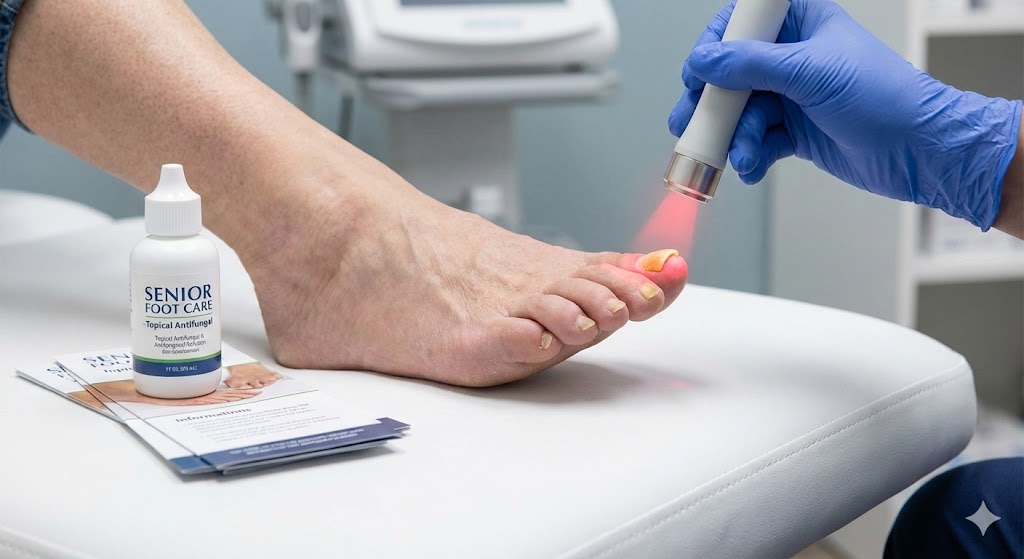
For seniors who cannot take oral pills and struggle with daily creams, laser treatment is a compelling option. It uses focused light to heat and kill the fungus without damaging the surrounding tissue. While expensive and not covered by insurance, it avoids all drug interaction risks.
5. Vicks VapoRub
Surprisingly, this common household item has some clinical backing. Small studies and anecdotal evidence suggest the camphor and eucalyptus oil can inhibit fungal growth. It is a safe, low-cost option to try for mild cases, though it is not a guaranteed cure.
6. Tea Tree Oil
This essential oil has natural antifungal and antiseptic properties. I suggest applying it twice daily to the affected nail after showering. While not as potent as prescription drugs, it is a safe maintenance tool to prevent spread.
7. Oral Terbinafine (With Strict Monitoring)
If the infection is severe and you are in good health, oral terbinafine remains the gold standard for cure rates. However, you must have your liver enzymes checked before and during treatment. It is effective, but it demands medical supervision.
Best Time & Dosage for Maximum Results
Consistency is the single most important factor in treating toenail fungus. Because senior nails grow slowly, you are looking at a 12 to 18-month timeline for a full cure. Stopping treatment when the nail “looks better” usually leads to immediate recurrence.
Topical treatments should be applied immediately after a shower when the nail is softest and pores are open. Drying your feet thoroughly before application is crucial, as fungus thrives in moisture. If using Vicks or urea, applying it before bed and covering with a cotton sock can drive the product deeper.
For oral medications, taking them at the same time daily helps maintain therapeutic blood levels. Missing doses allows the fungus to recover and develop resistance. Treat this like an antibiotic regimen, finish the entire course.
Safety & Precautions
1. Review Your Medication List
Before starting oral antifungals, have a pharmacist check for interactions with your blood pressure, cholesterol, or blood-thinning medications. The interaction risk is real and can be severe.
Safety Note: specific drug cocktails can be fatal.
2. Watch for Cellulitis
Seniors with diabetes or poor circulation are at high risk for secondary bacterial infections. If the skin around the nail becomes red, hot, or swollen, seek medical attention immediately. Fungus cracks the door open for bacteria.
Safety Note: Bacterial infections can spread rapidly in senior legs.
3. Avoid Aggressive Pedicures
While aesthetic improvement is desired, aggressive digging or cutting of the cuticle can cause trauma that spreads the fungus. Stick to medical pedicures performed by a podiatrist if possible.
Safety Note: Salon tools can introduce new pathogens.
4. Monitor Liver Symptoms
If you choose oral medication, be vigilant for signs of liver stress, such as unexplainable fatigue, nausea, or yellowing eyes. These require immediate cessation of the drug.
Safety Note: Liver toxicity is rare but serious.
5. Check Water Temperature
Seniors with neuropathy may not feel how hot water is. When soaking feet to soften nails, always check the temperature with your hand first to avoid burns.
Safety Note: Scalding burns can lead to non-healing ulcers.
5 Common Myths vs Facts
Myth 1: The fungus will go away on its own.
Fact: It never resolves spontaneously. Without treatment, it will spread to other toes and potentially cause skin infections.
Myth 2: Soaking in bleach cures fungus.
Fact: Bleach is corrosive and damages the skin, increasing infection risk. It does not penetrate the nail plate effectively.
Myth 3: Removing the nail cures the infection forever.
Fact: The fungus lives in the nail bed. If you remove the nail without treating the underlying tissue, the new nail will grow back infected.
Myth 4: Nail polish protects the nail from fungus.
Fact: Polish traps moisture in the nail bed, creating a perfect greenhouse for the fungus to multiply. Medicated polish is the exception.
Myth 5: It’s just a cosmetic issue.
Fact: For seniors, thick nails can cause pain while walking and lead to ulcers or falls. It is a functional mobility issue.
The Bottom Line
Treating toenail fungus in your senior years is a marathon, not a sprint.
Based on the research, I believe the combination of professional debridement (filing) and a prescription topical solution like Efinaconazole offers the best balance of safety and efficacy for most seniors. My take is that avoiding the risks of oral medication is worth the extra patience required for topical cures. Protecting your liver and existing medication regimen must come first.
Your next step should be to schedule a visit with a podiatrist to mechanically thin your nails, giving whichever treatment you choose a fighting chance to work.
Get Your FREE Ultimate Vitamin Guide!
Join the VitaminProGuide community to receive science-backed supplement reviews, nutritional insights, and absorption tips, delivered straight to your inbox.