- Safety: Most natural cortisol modulators are safe when taken at recommended dosages, but interactions with existing anxiety medications are possible.
- Effectiveness: Highly effective for “tired but wired” insomnia caused by a dysregulated HPA axis, but less effective for sleep issues unrelated to stress hormones.
- Key Benefit: They don’t just sedate you like traditional sleep aids; they target the physiological “alarm system” that keeps you awake, promoting natural, restorative rest.
If you think sleep anxiety is just about “racing thoughts,” think again. The biology tells a different story. It’s often a biochemical issue, not just a mental one.
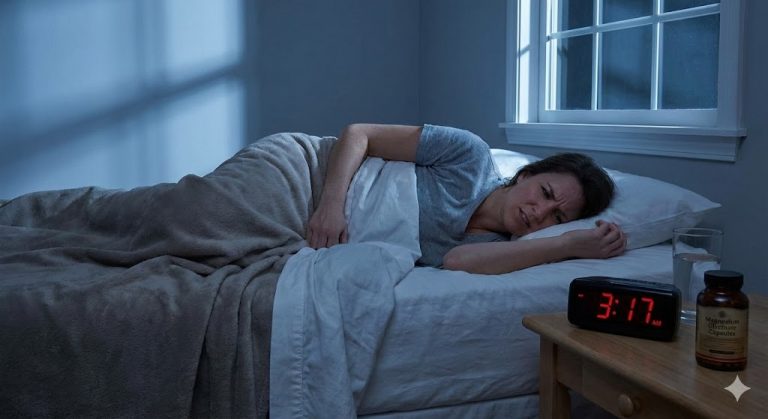
You are doing everything right: dark room, no screens, consistent bedtime. Yet, you lie there, exhausted but physically unable to drift off. It feels like an internal engine is revving. This “tired but wired” state is the hallmark of dysregulated stress hormones hitting you at the wrong time.
After reviewing the chemical analysis, the truth became clear on circadian rhythms and stress response. The research highlights one key factor: if your body is flooding with alertness hormones at 11 PM, no amount of chamomile tea will fix it. You need targeted intervention.
We need to discuss cortisol blockers for sleep anxiety. But first, we need to clarify what these compounds actually do, because the term “blocker” is a bit of a misnomer. We aren’t trying to eliminate cortisol; we are trying to stop the nighttime spikes that ruin your sleep.
Understanding Why Stress Levels Rise at Night
Cortisol is often demonized as the “stress hormone,” but it is vital for survival. It’s your body’s built-in alarm system and main wakefulness signal. In a healthy circadian rhythm, cortisol peaks in the morning to wake you up and gradually tapers off throughout the day, reaching its lowest point around midnight.
The problem arises when chronic stress throws this rhythm out of whack. This condition, often called HPA axis dysregulation, means your body keeps pumping out cortisol in the evening when it should be winding down. According to the National Institutes of Health (NIH), elevated nighttime cortisol is directly linked to sleep fragmentation and decreased slow-wave (restorative) sleep. High cortisol suppresses melatonin production. You physically cannot sleep because your biochemistry is screaming “Danger! Stay awake!”
Effective cortisol blockers for sleep anxiety—more accurately called cortisol modulators—work by blunting this inappropriate evening spike. They help reset the HPA axis feedback loop, allowing your natural melatonin to take over.
| Feature | Targeted Cortisol Modulators (e.g., Phosphatidylserine) | Standard Sleep Aids (e.g., Melatonin, Sedatives) |
|---|---|---|
| Primary Mechanism | Blunts the overactive stress response (HPA axis). | Signals “it’s dark” or acts as a general nervous system depressant. |
| Addresses Root Cause? | Yes, if stress is the driver. | No, usually symptom management. |
| Best For | “Tired but wired” insomnia, sleep anxiety, early waking. | Jet lag, shift work, general difficulty falling asleep. |
My Top Recommendations for Targeted Support
When we talk about “clinical-strength” natural options, we are looking for ingredients with human trials showing they can lower serum or salivary cortisol levels. Here are the most effective options.
1. Phosphatidylserine (PS)
This is perhaps the most targeted “cortisol blocker” available. PS is a phospholipid found in high concentrations in brain cell membranes. It works by blunting the pituitary gland’s signal to the adrenal glands to produce cortisol. Clinical studies suggest doses between 400mg to 800mg, taken in the late afternoon or evening, can significantly reduce post-exercise or evening cortisol spikes.
2. Ashwagandha (Sensoril® or KSM-66® Extracts)
Ashwagandha is a powerful adaptogen. It doesn’t just lower cortisol; it helps the body manage stress more efficiently overall. But quality matters immensely here. Generic root powder is often weak. Look for standardized extracts like Sensoril (often better for sleep/sedation) or KSM-66. Studies show consistent daily use can lower serum cortisol by up to 30%.
3. L-Theanine
Found naturally in green tea, L-Theanine is unique because it increases alpha brain waves, associated with a state of “relaxed alertness.” While not a direct cortisol blocker in the same mechanism as PS, it rapidly counteracts the excitatory effects of stress signals in the brain. It calms the racing mind component of sleep anxiety without causing drowsiness, usually within 30-40 minutes.
4. Magnolia Bark Extract (Honokiol and Magnolol)
Used in traditional medicine for centuries, modern research shows compounds in magnolia bark interact with GABA receptors in the brain—the same receptors targeted by benzodiazepines, but far gentler. It helps dampen overactive adrenaline and cortisol signaling, promoting physical relaxation.
Maximize your results
Timing is absolutely critical when using cortisol blockers for sleep anxiety. Taking these in the morning is usually a waste of money and might even leave you feeling groggy, as you need morning cortisol to wake up.
The goal is to preempt the evening spike. If your sleep anxiety usually kicks in around 10 PM, you want to take your supplement around 6 PM to 8 PM. This allows the ingredients time to enter your system and begin modulating the HPA axis before the ramp-up begins.
Dosage also matters. Start with the lowest effective clinical dose (e.g., 300mg of Ashwagandha or 400mg of Phosphatidylserine) and assess for a week before increasing. More is not always better; you want to nudge your rhythm back into balance, not crush it completely.
Finally, consider stacking. L-Theanine pairs exceptionally well with Magnesium Glycinate in the evening. The L-Theanine handles the mental chatter, while magnesium physically relaxes tense muscles. Adding Ashwagandha or PS to this stack addresses the deeper hormonal driver.
Safety & Precautions
1. Watch for Excessive Sedation
While these aren’t tranquilizers, combining them with prescription sleep meds, benzodiazepines, or even high doses of melatonin can lead to excessive grogginess the next day. Start with one new supplement at a time.
Safety Note: Don’t drive or operate heavy machinery until you know how you react.
2. Consult on Thyroid Issues
Ashwagandha can stimulate thyroid hormone production. This is great for some hypothyroid patients but can cause issues for those with hyperthyroidism or those already on thyroid medication.
Doctor’s Note: Get your TSH levels checked regularly if you use Ashwagandha long-term.
3. Check for Blood Pressure Interactions
Some adaptogens and relaxants can mildly lower blood pressure. If you are already taking anti-hypertensive medication, monitor your blood pressure closely to avoid hypotension (too low blood pressure).
Caution: Discuss with your cardiologist before starting a new regimen.
4. Pregnancy and Breastfeeding
Very few supplements have been proven safe during pregnancy. Cortisol is crucial for fetal development. Do not attempt to manipulate stress hormones during pregnancy without explicit medical oversight.
Heads Up: Assume these are unsafe during pregnancy unless told otherwise by an OB-GYN.
5. Cycle Your Adaptogens
While ingredients like PS and Magnesium can be taken daily long-term, some experts recommend cycling adaptogens like Ashwagandha (e.g., 3 months on, 1 month off) to maintain their effectiveness.
Pro Tip: Give your body a break occasionally to reassess your baseline.
Myths and the Truths
Myth 1: You should want zero cortisol.
Fact: If you had zero cortisol, you would be dead. It regulates blood pressure, glucose, and inflammation. You want balanced cortisol at the right times.
Myth 2: Cortisol blockers work instantly like a sleeping pill.
Fact: Some, like L-Theanine, work quickly on anxiety. Others, like Ashwagandha, are cumulative and may take 2–4 weeks to fully re-regulate the HPA axis.
Myth 3: Sleep anxiety is all in your head.
Fact: It is often a physiological state driven by elevated hormones. You cannot just “think positive” your way out of a cortisol spike.
Myth 4: If a little helps, a lot is better.
Fact: Crushing cortisol too low can lead to fatigue, low motivation, and inflammation. Stick to clinical dosages.
Myth 5: Melatonin fixes high cortisol.
Fact: High cortisol actively suppresses melatonin. Taking melatonin while cortisol is high is like turning on the AC while the heater is blasting—it’s fighting an uphill battle.
The Bottom Line
Standard sleep advice fails people with sleep anxiety because it ignores the biochemical reality of a dysregulated stress response.
Based on the research, I believe that using targeted cortisol blockers for sleep anxiety like Phosphatidylserine or high-quality Ashwagandha is the most logical approach for the “Skeptical Optimizer” who is tired but wired. These address the root hormonal cause rather than just sedating the symptom.
Choose a clinically validated ingredient, get the timing right in the evening, and give it a few weeks to reset your rhythm.
Get Your FREE Ultimate Vitamin Guide!
Join the VitaminProGuide community to receive science-backed supplement reviews, nutritional insights, and absorption tips, delivered straight to your inbox.