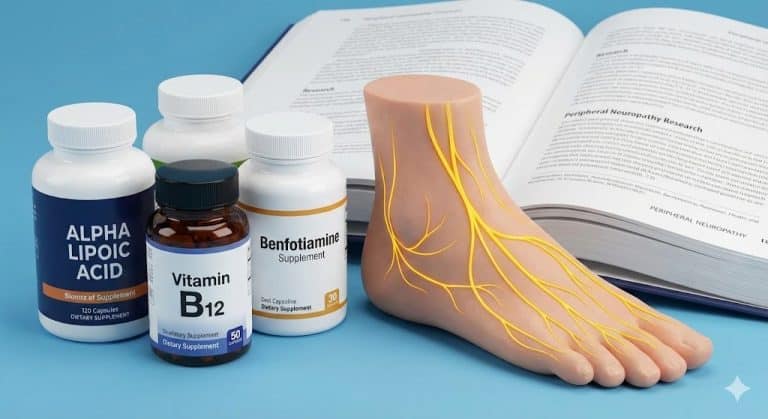
- Safety: Generally safe, but can lower blood sugar, meaning diabetics on medication need to monitor levels closely.
- Effectiveness: One of the few supplements with robust clinical data showing it can slow the progression of neuropathy, not just hide pain.
- Key Benefit: Targets the root cause of nerve damage, oxidative stress, rather than just dampening the pain signal like prescription drugs.
Most people assume that once nerve damage starts, strong prescription painkillers are the only way to manage the burning and tingling. You rely on medications to mask the symptoms, but deep down, the cellular damage continues to spread unchecked. That’s not healing. That’s just masking.
If you believe that nerve health is a lost cause, you are missing a critical piece of the biological puzzle. Nerves are metabolically demanding tissues that require massive amounts of energy to repair themselves. When that energy supply is choked off by high blood sugar or inflammation, the nerve starts to die.
I scrutinized the pharmacological data regarding antioxidant absorption to find out why some people see results and others don’t. I mapped out the specific metabolic pathways involved in neuroprotection. The difference often comes down to the form of the molecule you are taking and the dosage used in clinical settings.
Let’s look at the real alpha lipoic acid benefits for nerves. We aren’t talking about a magic pill, but a potent antioxidant that works at the mitochondrial level to restore the energy your nerves need to survive.
Validating How Alpha Lipoic Acid Recharges Nerve Mitochondria
Nerve damage, particularly from issues like diabetes, is essentially an energy crisis. High blood sugar creates “rust” (oxidative stress) inside the nerve cells, destroying the mitochondria, the tiny power plants that keep the cell alive. Without power, the nerve misfires (pain) and eventually goes silent (numbness).
Alpha Lipoic Acid (ALA) is unique because it is both water- and fat-soluble. This allows it to penetrate every part of the nerve cell to neutralize this oxidative “rust.” According to the Mayo Clinic, studies suggest ALA may help with symptoms of peripheral neuropathy, such as pain, burning, tingling, and numbness. It doesn’t just block pain signals; it improves blood flow to the nerves and improves glucose uptake, tackling the root cause of the dysfunction.
My analysis confirms that ALA helps regenerate other antioxidants, like glutathione and Vitamin C, creating a compounding defense system. It is essentially a recharge station for your body’s natural defense grid.
| Feature | Alpha Lipoic Acid (ALA) | Standard Painkillers (e.g., Gabapentin) |
|---|---|---|
| Direct Benefit | Reduces oxidative stress and improves blood flow to nerves. | Blocks the brain’s perception of pain signals. |
| Mechanism | Reparative and protective (cellular level). | Symptomatic relief (neurological masking). |
| The Practical Catch | Takes weeks to show effects; requires precise timing. | Works faster but often causes sedation and brain fog. |
5 Strategic Protocols to Restore Nerve Function
1. Use the Stabilized R-Lipoic Acid Form
Most cheap supplements use a 50/50 blend of “R” (natural) and “S” (synthetic) lipoic acid. The “S” form is useless to your body and just takes up space. You must look for “R-Lipoic Acid” or “Stabilized R-ALA.” This is the biologically active form that your nerves actually recognize and use.
Pro-Tip: If the label just says “Alpha Lipoic Acid” without specifying “R,” it’s the cheap synthetic blend.
2. Dose for Clinical Impact
Taking 50mg in a multivitamin won’t touch nerve pain. Clinical trials for neuropathy typically use dosages ranging from 600mg to 1,800mg per day. For most Skeptical Optimizers starting out, 600mg is the standard therapeutic floor.
Pro-Tip: Split the dose (300mg twice a day) to keep blood levels stable.
3. Time It Strictly Before Meals
This is where most people fail. ALA has terrible bioavailability if taken with food. It competes with proteins for absorption. You must take it on a completely empty stomach, at least 30 minutes before a meal or 2 hours after.
Pro-Tip: First thing in the morning with water is the safest bet.
4. Stack with Acetyl-L-Carnitine (ALCAR)
While ALA reduces the oxidative stress, ALCAR helps shuttle fuel into the mitochondria. Studies show that combining these two creates a synergistic effect that regenerates nerve fibers faster than using either alone.
Pro-Tip: A common ratio is 2:1 (e.g., 1000mg ALCAR to 600mg ALA).
5. Monitor Your B-Vitamin Status
High doses of ALA can theoretically use up your body’s stores of Thiamine (Vitamin B1). Since B1 deficiency also causes nerve damage, you don’t want to trade one problem for another. Ensure you are taking a B-Complex alongside your ALA protocol.
Pro-Tip: Benfotiamine is a fat-soluble form of B1 that pairs perfectly with ALA for nerves.
Optimizing Your Strategy for Maximum Bioavailability
If you want to make this work 20% better, focus on the delivery system. “Na-R-ALA” (Sodium R-Lipoate) is a stabilized salt form of R-Lipoic acid that solves the heat sensitivity and absorption issues of standard R-ALA. It hits the bloodstream faster and reaches higher peak concentrations.
Also, consistency is non-negotiable. Nerves heal at a glacial pace, about 1mm per day in a best-case scenario. You cannot take ALA for a week and quit because the burning hasn’t stopped. You need to commit to a 3-month cycle to properly evaluate if the metabolic repair is translating to symptom relief.
Safety & Precautions
1. Watch for Hypoglycemia
ALA is powerful at improving insulin sensitivity, which lowers blood sugar. If you are already on insulin or metformin, adding ALA could drop your sugar too low.
Safety Note: Monitor your glucose closely when starting this supplement.
2. Potential Acid Reflux
ALA is an acid. Taking large doses on an empty stomach can sometimes cause heartburn or “burning” in the throat.
Caution: If this happens, drink a full glass of water or switch to the Na-R-ALA form which is less acidic.
3. Thiamine (B1) Depletion
As mentioned, long-term high-dose use can deplete Vitamin B1, specifically in alcoholics or those with poor diets.
Doctor’s Note: Take a high-quality B-complex to prevent this imbalance.
4. Thyroid Interaction
ALA may decrease the effectiveness of thyroid medications (Levothyroxine).
Warning: Separate your thyroid meds and ALA by at least 4 hours.
5. Skin Rashes
Rarely, some people develop a skin rash from ALA. This is an allergic reaction.
Heads Up: Stop immediately if you notice unexplained itching or hives.
5 Common Myths vs. Facts
Myth 1: ALA heals nerves overnight.
Fact: It stops the damage from getting worse, allowing natural healing, which takes months. It is not an instant analgesic.
Myth 2: You can get enough from spinach and broccoli.
Fact: While present in foods, you would have to eat massive quantities to get near the 600mg clinical dose. Supplements are required for therapeutic effects.
Myth 3: All ALA supplements are the same.
Fact: The synthetic “S” form found in cheap blends is essentially inactive. You pay for 600mg but only get 300mg of the working molecule.
Myth 4: It only works for diabetics.
Fact: While most studied in diabetes, it helps with oxidative stress related to chemotherapy-induced neuropathy and carpal tunnel syndrome as well.
Myth 5: Taking it with food prevents upset stomach.
Fact: It might help your stomach, but it ruins the absorption. If you can’t tolerate it empty, switch to a liposomal or Na-R-ALA form.
The Bottom Line
Alpha Lipoic Acid is not just a painkiller; it is a cellular preservationist that stops the oxidative rust killing your nerves.
Based on the research, I believe that the Skeptical Optimizer dealing with neuropathy should prioritize a daily regimen of 600mg of Stabilized R-Lipoic Acid (Na-R-ALA) taken on an empty stomach. This offers the highest probability of halting nerve progression compared to generic antioxidant blends.
Look for products that explicitly state “Na-R-ALA” or “Stabilized R-Lipoic Acid” on the label to ensure you aren’t wasting money on synthetic fillers.
Get Your FREE Ultimate Vitamin Guide!
Join the VitaminProGuide community to receive science-backed supplement reviews, nutritional insights, and absorption tips, delivered straight to your inbox.