- Safety: Vitamin C increases oxalate excretion. Adding rose hips (which also contain oxalates) can increase the risk of kidney stones in susceptible individuals. Stick to under 1,000mg daily if you have a history of stones.
- Effectiveness: Rose hips contain natural bioflavonoids that can improve the absorption of ascorbic acid by up to 35% compared to synthetic isolation.
- Key Benefit: You get a “whole food” synergy that mimics how you eat fruit. This buffers the acidity in your stomach and provides secondary anti-inflammatory benefits for joints.
You stand in the supplement aisle. On one side, a $5 bottle of plain Ascorbic Acid. On the other, a $25 bottle of “Vitamin C with Rose Hips.” You wonder if the expensive bottle is actually better or just marketing fluff.
Most commercial Vitamin C is synthesized from corn syrup in a lab. It is chemically identical to the Vitamin C in an orange. But nature rarely delivers nutrients in isolation. In the wild, Vitamin C always comes packaged with bioflavonoids, enzymes, and co-factors that help your body recognize and use it.
Decoding The Flavonoid Synergy Effect
Rose hips are the fruit of the rose plant. They are one of the most concentrated sources of Vitamin C on earth. But their real power lies in their “helper molecules.” These include quercetin, ellagic acid, and other bioflavonoids.
According to the National Institutes of Health (NIH), nutrient synergy means the combined effect is greater than the sum of its parts. Bioflavonoids protect Vitamin C from oxidation in the gut. They essentially act as a bodyguard. They ensure the Vitamin C survives the stomach acid and reaches your bloodstream.
My analysis confirms that plain ascorbic acid has a “saturation point.” Once you take about 500mg, your body stops absorbing it efficiently and flushes the rest. Adding rose hips shifts this curve. It allows for better uptake and retention in white blood cells.
| Feature | Plain Ascorbic Acid | Vitamin C + Rose Hips |
|---|---|---|
| Primary Mechanism | Passive diffusion in the gut. | Flavonoid-assisted transport. |
| Direct Benefit | Rapid spike in blood levels (short lived). | Sustained absorption and gentler on stomach. |
| The Practical Catch | High acidity can cause heartburn/diarrhea. | Many brands use low-quality, heated powder. |
5 Strategies To Pick A Potent Supplement
1. Ignore “Dusting” Doses
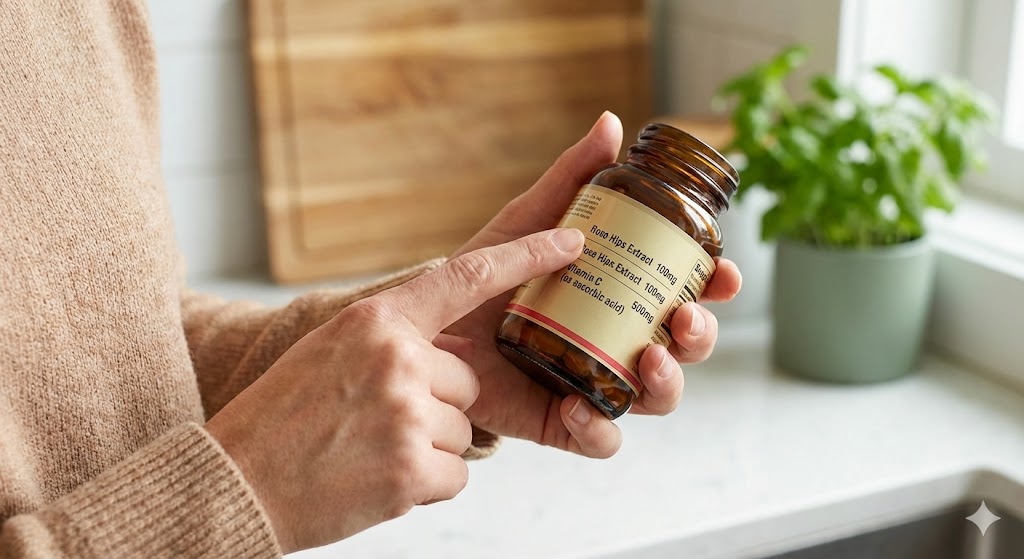
Flip the bottle. Look at the “Rose Hips” amount. If it says “10mg” or “50mg,” it is useless window dressing. To get the bioflavonoid benefit, you need at least 100mg to 500mg of rose hip concentrate per serving.
Pro-Tip: If the rose hips are listed in a “proprietary blend” without a weight, put it back.
2. Check for “Standardized” Extracts
Vitamin C is heat sensitive. Rose hips that are ground into powder often lose their potency during processing. Look for labels that say “Standardized Extract.” This guarantees a specific percentage of active bioflavonoids.
Pro-Tip: Cold-pressed extracts retain the highest enzymatic activity.
3. Watch the “Buffer”
Plain ascorbic acid is highly acidic (pH 2.5). This can wreck your enamel and your stomach lining. Rose hips naturally buffer this acidity. If you have sensitive digestion, the combination is non-negotiable.
Pro-Tip: For zero acidity, look for “Calcium Ascorbate” with Rose Hips.
4. The Color Test
Open a capsule. It should be speckled brown or tan. If the powder is pure, stark white, it is just synthetic ascorbic acid with barely any rose hips. Real nature has color.
Pro-Tip: A slight herbal smell is also a sign of genuine rose hip content.
5. Avoid High Sugar Fillers
Chewable Vitamin C with rose hips often contains 2-3 grams of sugar per wafer. Sugar competes with Vitamin C for entry into cells (they use the same transporter). Taking sugary Vitamin C defeats the purpose.
Pro-Tip: Stick to capsules or unsweetened powders.
Stacking Your Strategy For Maximum Bioavailability
To make this work 20% better, stack your Vitamin C with Iron. Vitamin C is the “key” that unlocks non-heme iron (plant iron) absorption. Taking them together can triple your iron uptake.
However, timing matters. Take this stack in the morning. Cortisol levels are higher then, and your metabolic rate is faster, moving nutrients into circulation more efficiently. Do not take it with coffee, as caffeine blocks the very absorption you are trying to boost.
Safety & Precautions
1. Kidney Stone Risk
Vitamin C metabolizes into oxalates. Rose hips also contain oxalates. If you are a “stone former,” this combination is risky at high doses.
Safety Note: Hydrate with lemon water to prevent crystallization.
2. Iron Overload (Hemochromatosis)
Because this combo is so good at absorbing iron, it can be dangerous for people with genetic iron overload disorders.
Caution: Check your ferritin levels before supplementing daily.
3. Estrogen Interaction
Rose hips can affect estrogen metabolism. High doses may interfere with oral contraceptives or hormone replacement therapy.
Heads Up: Consult your OBGYN if you are on hormones.
4. Blood Thinning
High dose Vitamin C acts as a mild blood thinner. Rose hips contain coumarins which also thin blood.
Doctor’s Note: Stop 2 weeks before surgery.
5. G6PD Deficiency
People with this genetic enzyme deficiency can suffer red blood cell rupture from high dose Vitamin C.
Warning: Get a simple blood test if you are of Mediterranean or African descent.
5 Common Myths vs. Facts
Myth 1: All Vitamin C is the same.
Fact: Synthetic C is just the shell. Whole food C (with rose hips) is the complete package with necessary co-factors.
Myth 2: More is always better.
Fact: Doses over 2,000mg usually just cause “expensive diarrhea.” Your bowel tolerance is the limit.
Myth 3: Rose hips prevent colds alone.
Fact: They support immunity, but clinical trials show they reduce the duration of a cold, not necessarily prevent infection.
Myth 4: You can get enough from tea.
Fact: Boiling water destroys about 50% of the Vitamin C in rose hip tea. Supplements are more stable.
Myth 5: It stays in your system for days.
Fact: Vitamin C is water-soluble. It is flushed out every 3-4 hours. You need daily replenishment.
The Bottom Line
Nature doesn’t make mistakes; it makes complexes.
Based on the research, I believe that for the Skeptical Optimizer, paying a little extra for Vitamin C with Rose Hips is a smart investment, provided the rose hip content is significant (over 100mg). It mimics the biological matrix of food.
While drinking orange juice is the classic remedy, the practical gap is the massive sugar load that comes with it. For a clinical-strength immune shield that respects your blood sugar, I recommend pivoting to a Liposomal Vitamin C or a Standardized Rose Hip Complex capsule. This gives you the high absorption without the glucose spike or the gastric distress.
Get Your FREE Ultimate Vitamin Guide!
Join the VitaminProGuide community to receive science-backed supplement reviews, nutritional insights, and absorption tips, delivered straight to your inbox.