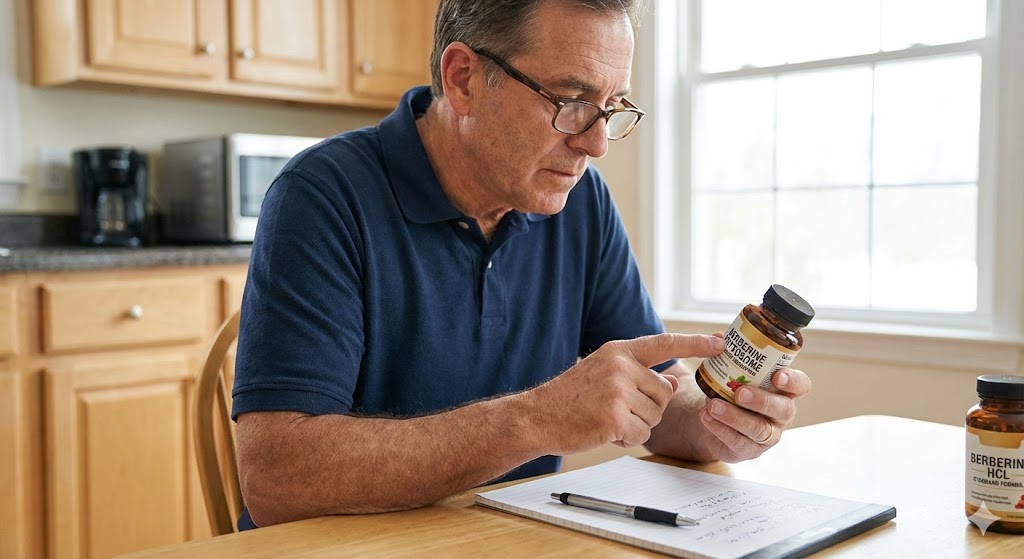
- Safety: Berberine inhibits CYP liver enzymes. This can potentiate (increase the strength of) medications like statins or beta-blockers. Phytosome forms are absorbed more efficiently, potentially increasing this interaction risk.
- Effectiveness: Clinical data indicates that Berberine Phytosome achieves up to 10 times the plasma concentration of standard Berberine HCL. This allows for lower dosing (550mg vs 1,500mg) with equal metabolic impact.
- Key Benefit: The lipid coating allows the molecule to bypass the self-limiting “P-glycoprotein” pump in the gut, ensuring the alkaloid actually reaches the bloodstream.
You take the yellow powder, expecting some metabolic magic, but instead end up with stomach cramps and digestive issues. This is the “Berberine Paradox.” It is one of the most potent metabolic activators in nature, yet it has some of the worst oral bioavailability of any supplement.
Standard Berberine HCL is hydrophilic. It dissolves in water but cannot cross the lipid-rich cell membranes of your gut wall. Your body also actively fights it. A transporter called P-glycoprotein pumps the berberine back out into the intestine almost as fast as you swallow it.
The biochemical facts show that just taking more powder isn’t the solution.; it just increases side effects. The data indicates that the battle of berberine phytosome vs hcl absorption is decided by the delivery system. You need a “Trojan Horse” to smuggle the molecule past the gut’s defenses.
Decoding The Lipid Transport System
A “Phytosome” is a patented technology. It binds a botanical molecule to a phospholipid (usually from sunflower lecithin). This creates a molecular complex that mimics your body’s own cell membranes. The gut lining recognizes the lipid and allows it to pass, carrying the berberine payload with it.
According to a pharmacokinetic study in the National Institutes of Health (NIH) database, this structure prevents the berberine from clumping together. It increases solubility in intestinal fluids. More importantly, it shields the alkaloid from the P-glycoprotein pump that usually ejects it.
Benchmarking the two reveals a clear efficiency gap. Standard HCL requires massive doses (1,500mg daily) to force enough into the blood to lower A1C. This often causes diarrhea. Phytosome formulations achieve similar metabolic activation with a third of the dose (550mg), significantly improving long-term compliance.
| Feature | Berberine Phytosome (Lipid-Bound) | Berberine HCL (Standard Salt) |
|---|---|---|
| Absorption Method | Lipid-mediated transport (Passive). | Paracellular diffusion (Inefficient). |
| Bioavailability | ~9.6x higher area under the curve (AUC). | Less than 5% absorbed. |
| The Practical Catch | Premium price point ($40+). | High risk of GI distress. |
5 Clinical Methods To Maximize Uptake
1. The Phytosome Mandate
If you can afford it, choose the Phytosome. Look for trademarked names like “Berbevis” or “Indena” on the ingredient panel. These have human clinical trials validating their absorption rates. Generic “lipid blends” are not the same as molecularly bonded phytosomes.
Pro-Tip: The dosage will look lower (e.g., 550mg). Do not double it; the potency is higher.
2. Fat Pairing For HCL
If you stick with the cheaper HCL form, never take it with water alone. You must take it with a meal containing at least 10g of fat. Avocado, eggs, or olive oil trigger bile release. Bile acts as a natural emulsifier, helping the yellow powder dissolve.
Pro-Tip: Taking HCL fasted wastes 90% of the product.
3. The “Silymarin” Stack
Milk Thistle (Silymarin) is a natural inhibitor of P-glycoprotein. Taking Berberine with Milk Thistle essentially turns off the “eject button” in your gut. This allows more HCL to stay in your system. Many advanced formulas combine these two for this exact reason.
Pro-Tip: Look for a 1:1 ratio supplement.
4. Split Dosing Strategy
Regardless of the form, Berberine has a short half-life. A massive single dose spikes blood levels and then crashes. Splitting your intake into two or three smaller doses maintains steady AMPK activation throughout the day.
Pro-Tip: Take it 15 minutes before your two largest meals.
5. Gut Microbiome Modulation
Berberine alters gut bacteria. In some, this causes bloating initially. The Phytosome form is absorbed higher up in the GI tract, leaving less residue in the colon to ferment. If HCL makes you gassy, the Phytosome is the necessary pivot.
Pro-Tip: Start with one pill a day for 3 days to let your biome adjust.
Stacking Your Strategy For Metabolic Control
To make this work 20% better, stack your Berberine Phytosome with Chromium Picolinate. While Berberine activates the insulin receptor from the inside (AMPK), Chromium sensitizes the receptor from the outside.
Chromium helps the insulin molecule dock efficiently. Berberine forces the cell to use the glucose. By combining them, you attack insulin resistance from both the signaling and the utilization pathways. This stack is particularly effective for post-meal glucose spikes.
Safety & Precautions
1. Hypoglycemia Risk
Because the Phytosome absorbs so well, it can drop blood sugar rapidly. If you are already on Metformin or insulin, this can be dangerous.
Safety Note: Monitor your glucose closely when switching forms.
2. Muscle Building
Berberine inhibits mTOR, the pathway for muscle growth. Taking it immediately after lifting weights might blunt your gains.
Caution: Take it on rest days or at meals away from your workout window.
3. Pregnancy
Berberine can displace bilirubin. In newborns, this can cause brain damage (kernicterus).
Heads Up: Strictly contraindicated for pregnant or nursing women.
4. Drug Potentiation
The Phytosome form stays in the blood longer. This means it has more time to interact with liver enzymes.
Doctor’s Note: If you take Cyclosporine or Macrolides, ask your pharmacist.
5. False “Keto” Pills
Some brands mix trace amounts of Berberine with MCT oil and call it a “complex.”
Warning: Ensure the label specifies the exact milligram amount of the active alkaloid.
5 Common Myths vs. Facts
Myth 1: You need 1,500mg of Phytosome.
Fact: No. 1,500mg is the dose for HCL. Because Phytosome is 4-10x more absorbable, 500-600mg is the therapeutic equivalent.
Myth 2: It damages the liver.
Fact: Studies show Berberine actually helps Fatty Liver (NAFLD) by reducing liver fat accumulation. It is hepatoprotective, not toxic, at normal doses.
Myth 3: Dihydroberberine is the same as Phytosome.
Fact: Dihydroberberine is a chemically reduced form (DHB). Phytosome is a lipid-encapsulated form. Both are superior to HCL, but they use different mechanisms.
Myth 4: You feel it instantly.
Fact: Metabolic changes take weeks. You might feel GI changes instantly, but the A1C drop takes 90 days to manifest.
Myth 5: Cinnamon works just as well.
Fact: Cinnamon is a mild sensitizer. Berberine is a pharmaceutical-grade alkaloid. The potency difference is significant.
The Bottom Line
Absorption dictates efficacy.
From what the research shows, I think Berberine Phytosome is the best option for the Skeptical Optimizer. It overcomes the biological barriers that render standard HCL ineffective for many people. It delivers consistent blood levels without the gastrointestinal punishment.
The practical catch is the price per serving. For a clinical-strength result that actually reaches your cells, I recommend pivoting to a Standardized Phytosome taken twice daily. Stack it with Chromium to ensure your metabolic machinery is firing on all cylinders.
Get Your FREE Ultimate Vitamin Guide!
Join the VitaminProGuide community to receive science-backed supplement reviews, nutritional insights, and absorption tips, delivered straight to your inbox.