- Safety: Men should generally avoid multivitamins with Iron. Unlike women, men have no monthly output for iron, and excess levels can damage the heart and liver.
- Effectiveness: A quality men’s multi must use “methylated” B-vitamins (e.g., Methylfolate) rather than synthetic Folic Acid to bypass common genetic absorption bottlenecks.
- Key Benefit: Filling specific nutrient gaps (like Zinc and Magnesium) to support testosterone production and sustained daily energy without the “crash.”
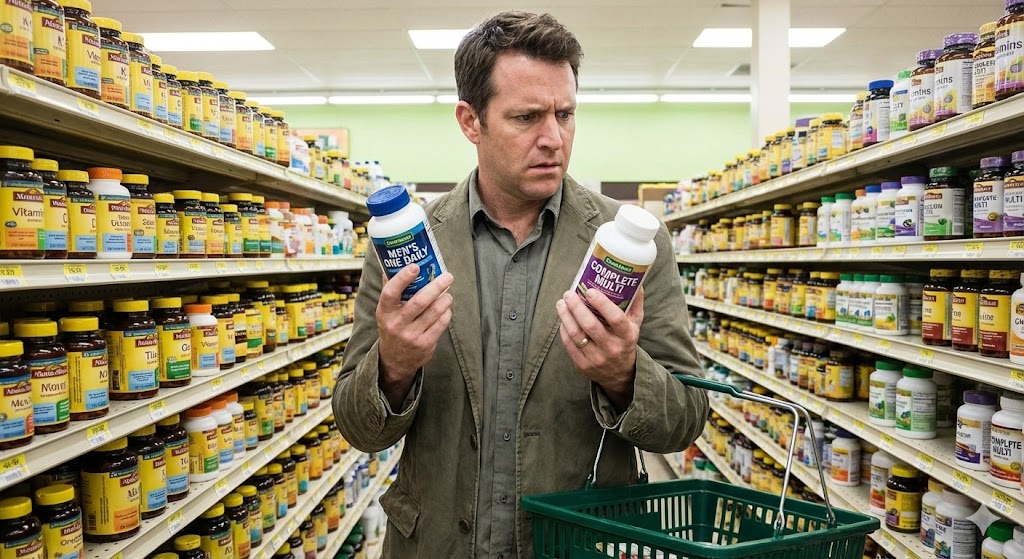
You stand in the supplement aisle. You are staring at a wall of 50 different bottles. Some claim to boost testosterone. Others promise “energy.” Most are just compressed dust held together with cheap binders.
For men, the problem isn’t finding a multivitamin; it is finding one that isn’t just expensive urine. The male physiology has distinct requirements that generic “one-a-day” pills ignore. We do not need extra Iron. We do need higher Zinc. And we often struggle to process synthetic B-vitamins due to genetic variations.
I analyzed the men’s health specific metabolic pathways to identify which nutrients genuinely drive measurable impact. I cross-referenced the bioavailability of chelated minerals against the cheap oxides found in grocery store brands. The data suggests that the best multivitamin for men is not a magic bullet, but a targeted “gap filler” that respects your biology.
Here are the 5 proven criteria to ensure you are buying a clinical-strength tool, not a placebo.
Decoding The Methylation Advantage
The most critical difference between a $10 multivitamin and a $40 one is the form of Vitamin B9 (Folate) and B12. Cheap brands use Folic Acid and Cyanocobalamin. These are synthetic. To use them, your body must convert them into active forms through a process called methylation.
However, according to the Linus Pauling Institute, about 40% to 60% of the population has a genetic variation (MTHFR) that makes this conversion inefficient. If you cannot methylate well, synthetic Folic Acid can build up in your blood, potentially blocking the receptors for the real nutrients.
My analysis confirms that the “Skeptical Optimizer” should demand the active forms: 5-MTHF (Methylfolate) and Methylcobalamin. These bypass the genetic bottleneck. They are biologically ready to work the moment they hit your bloodstream. This equates to real energy, not just a jittery spike.
| Feature | Clinical-Strength Multi (Premium) | Grocery Store Generic (Cheap) |
|---|---|---|
| Vitamin B9 Source | L-Methylfolate (5-MTHF). | Synthetic Folic Acid. |
| Direct Benefit | Bypasses MTHFR mutations for instant use. | Requires enzymatic conversion; may fail. |
| The Practical Catch | Costs 3x more to manufacture. | Can accumulate unmetabolized in blood. |
5 Signs You Found The Right Formula
1. The “No Iron” Rule
Unless you are a vegan or have diagnosed anemia, you do not need iron. Men store iron efficiently. Excess iron acts as a pro-oxidant, rusting your organs from the inside out and increasing the risk of heart disease.
Pro-Tip: Check the label. If it says “Iron… 18mg (100% DV),” put it back.
2. ZincDosage for T-Levels
Zinc is essential for testosterone production. A mild deficiency is linked to hypogonadism (low T). The best multivitamins for men provide at least 15mg to 30mg of Zinc, ideally balanced with a small amount of Copper to prevent depletion.
Pro-Tip: Look for “Zinc Bisglycinate” or “Picolinate” for better absorption than “Zinc Oxide.”
3. Vitamin D3 Baseline
Most multis contain a pathetic 400 IU of Vitamin D. This is outdated. To maintain healthy levels, especially for indoor workers, you need closer to 2,000 IU daily. A top-tier multi will reflect this modern reality.
Pro-Tip: It must be D3 (Cholecalciferol), not the plant-based D2 (Ergocalciferol).
4. Chelated Minerals
Minerals like Magnesium and Zinc are unstable rocks. To get them into your blood, they need to be bound to an amino acid (chelated). Cheap brands use “Oxides” or “Carbonates” (chalk). Good brands use “Glycinates” or “Citrates.”
Pro-Tip: “Magnesium Oxide” is a red flag that the company is cutting corners.
5. Active Vitamin A (Retinol)
Beta-Carotene (from carrots) is great, but your body has to convert it to Retinol to use it. This conversion can be poor in some men. A superior multi includes a mix of Beta-Carotene and Retinyl Palmitate (pre-formed Vitamin A).
Pro-Tip: This is crucial for night vision and immune defense.
Enhancing Absorption With Fat
To make this work 20% better, never take your multivitamin with just coffee. Vitamins A, D, E, and K are fat-soluble. If you take them on an empty stomach, they pass right through you.
Pair your morning stack with eggs, avocado, or a spoonful of nut butter. The dietary fat triggers bile release, which emulsifies these vitamins and shuttles them across the intestinal wall. This simple habit change can double the ROI of your expensive supplement.
Safety & Precautions
1. Iron Overload (Hemochromatosis)
Hereditary hemochromatosis is common in men of Northern European descent. It causes toxic iron buildup. Taking an iron-containing multi can be dangerous for this group.
Safety Note: A simple ferritin blood test can confirm if you are at risk.
2. B6 Toxicity
Some “Energy” multis pack 50mg or 100mg of Vitamin B6. Long-term use of high-dose synthetic B6 (Pyridoxine HCl) can cause nerve damage (neuropathy).
Caution: Stick to brands using the active P-5-P form, or keep the dose under 20mg.
3. Medication Interactions
Vitamin K interferes with blood thinners like Warfarin. Calcium can block antibiotic absorption.
Doctor’s Note: Separate your multi from prescription meds by at least 4 hours.
4. The “Smoker’s Paradox”
High doses of isolated Beta-Carotene have been linked to increased lung cancer risk in smokers.
Heads Up: If you smoke, choose a multi with Retinyl Palmitate instead of just Beta-Carotene.
5. Zinc-Copper Imbalance
Taking high Zinc (50mg+) without Copper for months can lead to a copper deficiency, which mimics anemia.
Warning: Ensure your multi has a small amount of Copper (e.g., 1-2mg) if Zinc is high.
5 Common Myths vs. Facts
Myth 1: You pee out all vitamins.
Fact: You pee out the water-soluble ones (B and C) you don’t need instantly. Fat-soluble ones (A, D, E, K) are stored. “Expensive urine” means your kidneys are working, not that the vitamins failed.
Myth 2: One pill covers a bad diet.
Fact: A multi is an insurance policy, not a license to eat trash. It cannot replace the thousands of phytonutrients in real food.
Myth 3: More is always better.
Fact: Mega-dosing (like 5,000% DV) puts stress on your liver and kidneys. The goal is sufficiency, not excess.
Myth 4: Gummies are just as good.
Fact: Gummies usually lack Iron (good for men) but also lack bulky minerals like Magnesium because they mess up the texture. They are often candy with a dusting of vitamins.
Myth 5: All B12 is the same.
Fact: Cyanocobalamin contains a cyanide molecule (tiny amount, but still). Methylcobalamin is the bio-identical form found in nature.
The Bottom Line
You don’t need a “mega-dose”; you need a “bio-match.”
Based on the research, I believe that for the Skeptical Optimizer, the best multivitamin strategy is to find a formula that respects male physiology. That means strictly no iron, methylated B-vitamins, and chelated minerals.
While eating liver and oysters every day would be the ideal natural solution, the practical gap is that modern diets rarely support that consistency. For a convenient, clinical-strength baseline that covers your nutritional blind spots, I recommend pivoting to a Methylated B-Complex Multivitamin (Iron-Free). This ensures you fuel your methylation cycle and testosterone production without burdening your liver with synthetic fillers.
Get Your FREE Ultimate Vitamin Guide!
Join the VitaminProGuide community to receive science-backed supplement reviews, nutritional insights, and absorption tips, delivered straight to your inbox.