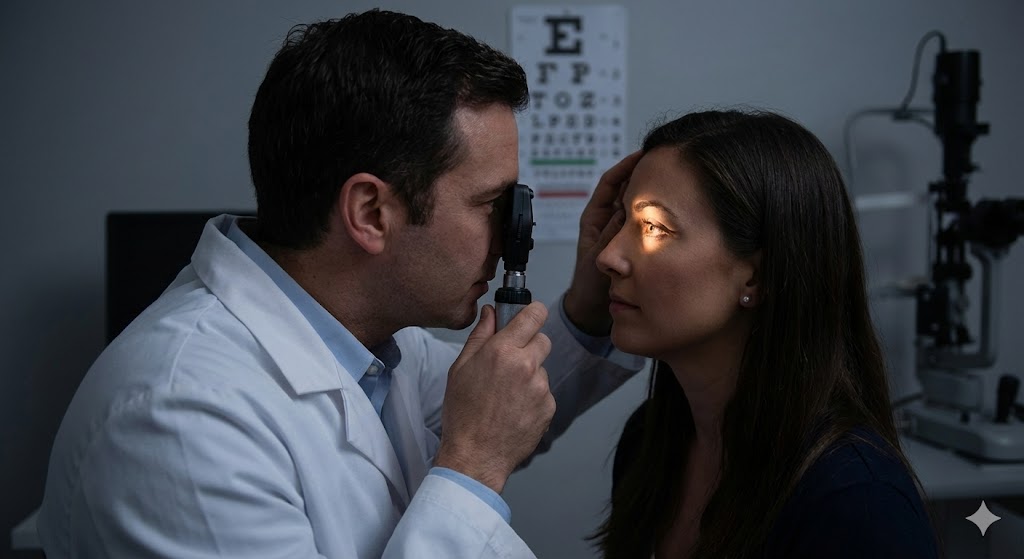
- Safety: Sudden onset of many new floaters, especially if accompanied by flashes of light (like a camera flash) or a “curtain” over your vision, is a medical emergency. It signals a retinal tear or detachment. Go to the ER immediately to prevent permanent blindness.
- Effectiveness: Most floaters are benign and caused by the natural aging of the vitreous humor. There is no proven “cure” via eye drops, though laser vitreolysis can break up large, obstructive floaters in select cases.
- Key Benefit: Understanding the mechanics of Posterior Vitreous Detachment (PVD) helps distinguish between harmless aging and sight-threatening tears.
When you gaze at a clear blue sky, you might notice tiny squiggles, dots, or cobweb-like shapes drifting through your vision. They shift as your eyes move—these are floaters. Most of the time, they’re just harmless bits of debris, but occasionally, they can be an early warning sign of serious retinal trouble.
The eye is filled with a gel called the vitreous humor. When we are young, it is firm like Jell-O. As we age, it liquefies and shrinks. This shrinkage pulls on the retina, the light-sensitive wallpaper at the back of the eye. This mechanical tug-of-war is the root cause of both floaters and flashes.
The difference comes down to structure. I looked into the pathophysiology of vitreous syneresis and found that eye floaters and flashes are usually caused by harmless protein clumps. However, flashes can signal traction—a pulling on the retina that could potentially tear it.
Physiologically Speaking: The Vitreous Collapse
The vitreous is 99% water and 1% collagen. Over time, the collagen fibers clump together. These clumps cast shadows on the retina. These shadows are what you see as floaters. They are not on the surface of your eye; they are floating inside it.
Physiologically speaking, as the vitreous shrinks, it peels away from the retina. This is called Posterior Vitreous Detachment (PVD). Ideally, it peels cleanly. If it sticks, it tugs. This tug stimulates the retina, sending a signal to the brain that looks like a flash of light (photopsia). If it pulls too hard, it tears the retina, allowing fluid to seep behind it and detach it from the blood supply.
A direct comparison reveals the urgency. A floater is a shadow (passive). A flash is a signal of mechanical stress (active). According to the American Academy of Ophthalmology, flashes mean the vitreous is still pulling. Until the flashes stop, the risk of a tear remains high.
| Feature | Floaters (Shadows) | Flashes (Photopsia) |
|---|---|---|
| Visual Experience | Dark specks, worms, or clouds. | Lightning streaks or camera flashes. |
| Primary Cause | Collagen clumping (Syneresis). | Vitreous traction on retina. |
| The Practical Catch | Usually permanent but fades. | Sign of active pulling/risk. |
5 Clinical Signs It’s An Emergency
1. The “Shower” of Floaters
If you suddenly see hundreds of tiny black dots (like pepper), this is not collagen. It is likely red blood cells hemorrhaging into the vitreous from a torn retinal vessel. This is a definitive sign of a tear.
Pro-Tip: Do not wait for pain; the retina has no pain receptors.
2. The Curtain Effect
If a grey or black shadow starts creeping in from the side of your vision, your retina is detaching. It looks like a curtain closing. Once it covers the center (macula), central vision is lost forever.
Pro-Tip: Cover one eye at a time to check your peripheral field daily if you have flashes.
3. Lightning in Daylight
Flashes are usually seen in the dark. If they are intense enough to be seen in a lit room, the traction is severe.
Pro-Tip: Note the direction of the flash; it usually corresponds to the opposite side of the retina being pulled.
4. High Myopia Risk
Nearsighted people (high myopia) have longer eyeballs, stretching the retina thinner. They are at significantly higher risk for tears during PVD.
Heads Up: If you have a prescription over -6.00, take any new floater seriously.
5. Trauma History
A hit to the head or eye can induce a PVD or tear instantly. If floaters appear after an injury (even days later), get a dilated exam.
Doctor’s Note: Boxers and contact sport athletes should have regular retinal screenings.
Stacking Your Strategy For Eye Health
To make this work 20% better, stack your Regular Eye Exams with Lutein and Zeaxanthin.
While supplements cannot dissolve existing floaters (they are physical collagen clumps), antioxidants like Lutein, Zeaxanthin, and Vitamin C protect the vitreous from further oxidative stress. This slows down the liquefaction process. By keeping the vitreous stable for longer, you delay the onset of PVD and potentially reduce the severity of future floaters.
Safety & Precautions
1. “Eye Floater Drops”
Do not waste money on MSM or “floater dissolving” drops.
Safety Note: There is zero clinical evidence that topical drops can penetrate to the vitreous chamber to dissolve collagen.
2. Laser Surgery (YAG)
Laser vitreolysis can zap large floaters, but it carries risks of hitting the lens or retina.
Caution: Only consider this if the floater significantly impairs vision, not just for annoyance.
3. Vitrectomy
Surgically removing the vitreous (and floaters) is the only “cure,” but it causes cataracts in nearly 100% of patients.
Heads Up: This is a nuclear option reserved for debilitating cases.
4. Hydration
The vitreous is 99% water. Chronic dehydration can theoretically accelerate shrinkage.
Doctor’s Note: Drink water, but don’t expect it to re-inflate a detached vitreous.
5. Pineapple Enzyme (Bromelain)
A viral study suggested eating pineapple clears floaters. The evidence is weak and the required dosage of bromelain is massive.
Warning: Eating 3 pineapples a day will destroy your mouth (acid/enzyme) before it fixes your eyes.
5 Common Myths vs. Facts
Myth 1: Floaters go away.
Fact: They rarely disappear. They usually settle at the bottom of the eye (gravity) or the brain learns to ignore them (neuroadaptation). You stop seeing them, but they are still there.
Myth 2: Eye exercises fix them.
Fact: Moving your eyes shifts the fluid, but it doesn’t break up the clumps. No amount of looking left-and-right will dissolve collagen.
Myth 3: Only old people get them.
Fact: Young people with myopia or history of inflammation (uveitis) can get them in their 20s.
Myth 4: A sudden flash is a migraine.
Fact: Ocular migraines cause jagged, expanding “aura” lines that last 20 minutes. Retinal flashes are instant “pops” of light like a camera. They are distinct.
Myth 5: Rubbing your eyes helps.
Fact: Rubbing your eyes vigorously can actually induce a PVD or tear. Be gentle with your eyes.
The Bottom Line
Flashes are the fire alarm.
My analysis concludes that for the efficiency-minded patient, understanding the PVD Process is the key to eye safety. Floaters are the smoke; flashes are the fire. If you see the smoke without the fire, monitor it. If you see the fire (flashes) or the house collapsing (curtain), act instantly.
The thing is, neuroadaptation takes months. For a strong, clinical-level approach to protecting your vision, consider switching to an annual dilated eye exam (not just a basic vision check) to keep tabs on your retinal health. Pair that with protective eyewear during sports to help prevent trauma-related tears.
Get Your FREE Ultimate Vitamin Guide!
Join the VitaminProGuide community to receive science-backed supplement reviews, nutritional insights, and absorption tips, delivered straight to your inbox.