- Safety: Using anti-acne products (like benzoyl peroxide) on fungal acne can worsen the infection by killing the beneficial bacteria that keep the fungus in check. Misdiagnosis leads to prolonged skin barrier damage.
- Effectiveness: Fungal acne (Malassezia folliculitis) responds to antifungals like ketoconazole, not traditional acne meds. Closed comedones (whiteheads) respond to exfoliants like salicylic acid and retinoids.
- Key Benefit: Correctly identifying the “itch” factor allows you to switch from ineffective acne creams to a targeted antifungal routine, clearing the bumps in days rather than months.
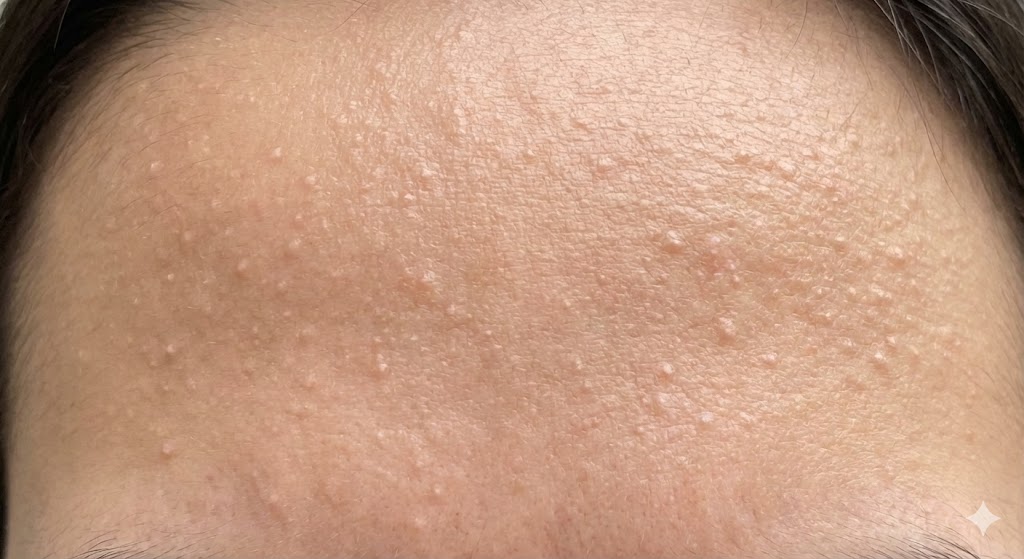
You notice hundreds of tiny, flesh-colored bumps on your forehead. You scrub, apply salicylic acid, even try retinol, but nothing helps; if anything, it gets worse. You figure it’s just stubborn acne, but it might not be acne at all.
Traditional acne is bacterial. Fungal acne is, as the name suggests, fungal. It is an overgrowth of yeast that lives on everyone’s skin. When this yeast (Malassezia) grows out of control, it invades the hair follicle, creating bumps that look identical to clogged pores but behave very differently.
The difference comes down to microbes. I compared the clinical signs of Malassezia and C. acnes, and the evidence points to two main sensory clues that separate fungal acne from closed comedones: how uniform they look and whether they itch.
Physiologically Speaking: Yeast vs. Bacteria
Closed comedones are plugs of sebum and keratin. They are non-inflammatory “whiteheads.” They happen when dead skin cells get trapped in the pore. They vary in size and are usually painless.
Physiologically speaking, fungal acne is an infection of the hair follicle (folliculitis). The yeast feeds on the fatty acids in your sebum. As it multiplies, it causes inflammation. The result is a cluster of uniform, monomorphic papules (bumps that all look the same size). Unlike bacterial acne, which hurts, fungal acne itches.
A direct comparison reveals the trigger. Bacterial acne thrives on oil but is killed by antibiotics. Fungal acne thrives on oil and is made worse by antibiotics because the drugs kill the bacteria that usually compete with the yeast. A study in the Journal of Clinical and Aesthetic Dermatology notes that prolonged antibiotic use is a primary risk factor for developing fungal acne.
| Feature | Fungal Acne (Malassezia) | Closed Comedones (Acne Vulgaris) |
|---|---|---|
| Primary Sensation | Intense Itching (Pruritus). | Painless or tender if inflamed. |
| Appearance | Uniform size; clustered clusters. | Varying sizes; scattered. |
| The Practical Catch | Worsened by antibiotics/oils. | Improved by retinoids/acids. |
5 Clinical Clues To Spot The Fungus
1. The “Itch” Factor
This is the hallmark. Does your face itch when you sweat or get hot? Bacterial acne rarely itches. Fungal infections almost always do. If you find yourself scratching your forehead bumps, it is likely fungal.
Pro-Tip: The itch is often worse at night or after a workout.
2. Uniformity of Lesions
Fungal acne bumps look like clones. They are all roughly 1-2mm in diameter. Closed comedones are messy; some are big, some are small, some are blackheads. If the breakout looks “organized,” suspect fungus.
Pro-Tip: Look closely in a mirror; if it looks like a rash, treat it like a rash.
3. Location, Location, Location
Fungal acne loves sweat and heat. It often appears on the forehead (under bangs), the chest, the back, and the shoulders. Closed comedones usually stick to the T-zone or chin.
Pro-Tip: If you have “acne” on your back and chest that itches, it is almost certainly Malassezia.
4. Antibiotic Failure
Did you take doxycycline or minocycline and see your acne get worse? This is a massive red flag. You killed the competition, allowing the yeast to take over.
Pro-Tip: Stop the antibiotics and consult your dermatologist about antifungals.
5. The “Dandruff” Connection
Malassezia is the same yeast that causes dandruff (seborrheic dermatitis). If you have a flaky scalp or scaly patches around your nose/eyebrows, you are prone to yeast overgrowth.
Pro-Tip: Use your dandruff shampoo as a face wash to see if it helps.
Stacking Your Strategy For Clearance
To make this work 20% better, stack your Nizoral (Ketoconazole) Mask with a Fungal-Safe Moisturizer.
Ketoconazole kills the yeast. However, if you follow it up with a moisturizer containing fatty acids, oils, or esters, you are feeding the yeast right back. Malassezia eats lipids with carbon chain lengths of 11-24. You must use a “fungal-safe” moisturizer (usually squalane or MCT oil based) to starve the colony while you bomb it.
Safety & Precautions
1. Over-Drying
Nizoral is harsh on the skin barrier.
Safety Note: Use it as a 5-minute mask every other day, not a daily cleanser, to prevent chemical burns.
2. Steroid Withdrawal
Topical steroids feed fungal infections massively.
Caution: Never put hydrocortisone on “acne” unless you are 100% sure it’s not fungal.
3. “Natural” Oils
Coconut oil, olive oil, and almost all plant oils feed the yeast.
Heads Up: Stop “slugging” or using oil cleansers immediately.
4. Diagnosis Confirmation
A dermatologist can do a simple skin scrape (KOH test) to see the yeast under a microscope.
Doctor’s Note: Get tested if over-the-counter antifungals don’t work in 2 weeks.
5. Oral Antifungals
Fluconazole (Diflucan) is highly effective but hard on the liver.
Warning: Only take oral pills under doctor supervision.
5 Common Myths vs. Facts
Myth 1: It’s just sweat bumps.
Fact: Sweat doesn’t cause bumps; the yeast feasting on the sweat causes the infection. You need to kill the yeast, not just stop sweating.
Myth 2: Sun kills it.
Fact: UV light might temporarily suppress it, but the heat and sweat from sun exposure usually trigger a massive flare-up afterward.
Myth 3: You can pop them.
Fact: Fungal acne bumps are not filled with pus like whiteheads. They are filled with inflammatory fluid. Squeezing them just damages the skin and spreads the yeast.
Myth 4: It’s contagious.
Fact: Malassezia is already on everyone’s skin. You can’t “catch” it. It’s an internal imbalance of your own microbiome.
Myth 5: Exfoliation fixes it.
Fact: Scrubbing irritates the infected follicles. Chemical exfoliation (Salicylic Acid/BHA) helps, but physical scrubbing makes it worse.
The Bottom Line
Feed the skin, starve the yeast.
For those who value efficiency, telling fungal acne apart from closed comedones can mean the difference between years of frustration and a quick three-day fix. If it itches, it’s probably fungus. If the bumps are uniform, it’s probably fungus. Stop treating it like it’s bacterial.
The tricky part is the product audit; every ingredient needs checking. For fast, effective results, switch to a ketoconazole shampoo mask routine and pair it with sugarcane-derived squalane oil for moisture, one of the rare oils the yeast can’t feed on.
Get Your FREE Ultimate Vitamin Guide!
Join the VitaminProGuide community to receive science-backed supplement reviews, nutritional insights, and absorption tips, delivered straight to your inbox.