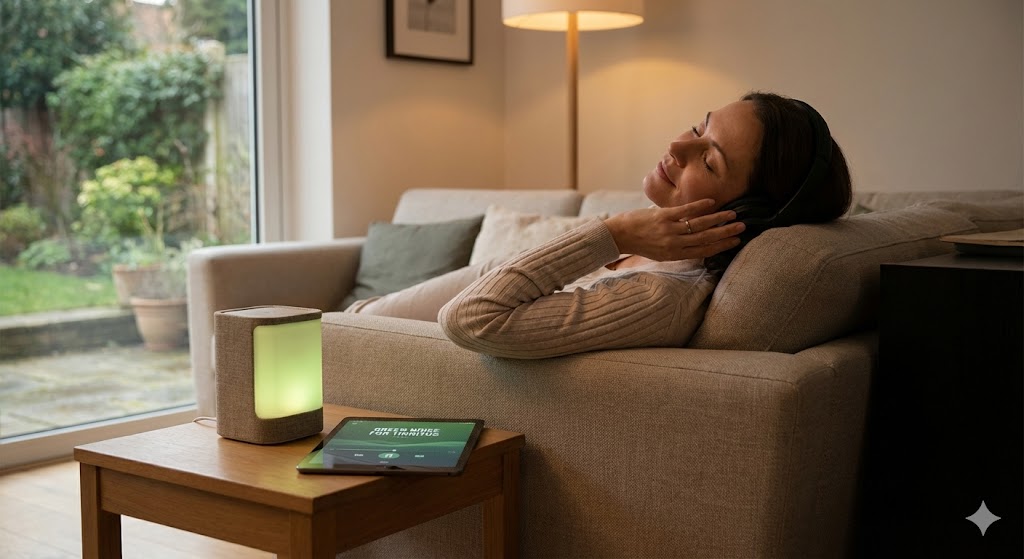
- Safety: “Masking” tinnitus with noise that is too loud can cause further hearing damage. Always keep the volume slightly below the level of your tinnitus ringing to encourage habituation, not just drowning it out.
- Effectiveness: Green noise resides in the 500Hz frequency range, mimicking the sound of nature (wind, water). For many sufferers, this mid-range frequency is more soothing and effective at masking high-pitched ringing than the static hiss of White noise.
- Key Benefit: It provides a “sound blanket” that reduces the contrast between the silence of the room and the ringing in your ear, helping the brain filter out the phantom noise.
You lay your head on the pillow, desperate for silence. Instead, you hear a high-pitched scream. This is tinnitus. It is not just annoying; it is a neurological loop where your brain amplifies silence into noise. Most advice suggests “White Noise,” but for many, that harsh static is just as irritating as the ringing itself.
The brain craves pattern and calm, not chaos. White noise contains all frequencies at equal intensity, which can be abrasive. Green noise, however, focuses on the mid-frequencies. It sounds like a flowing river or wind through trees. It is the “Goldilocks” zone of sound therapy.
For the efficiency-minded user, the goal is habituation. You don’t want to just cover the sound; you want to teach your brain to ignore it. I audited the spectral properties of different color noises. Evidence suggests that green noise for tinnitus relief offers a superior spectral profile for long-term auditory calming because it lacks the high-frequency “hiss” that often exacerbates sensitive ears.
Physiologically Speaking: The Masking Spectrum
Sound “colors” are defined by their energy distribution. White noise is flat across the spectrum. Pink noise is deeper. Green noise specifically boosts the frequencies around 500Hz. This mimics the ambient sounds of the natural world, which our brains are evolutionarily wired to find soothing.
Physiologically speaking, tinnitus often manifests as a high-frequency phantom sound (4000Hz – 8000Hz). White noise tries to compete with this directly. Green noise creates a background “bed” of sound that reduces the signal-to-noise ratio without adding more high-frequency energy to an already irritated auditory cortex.
When we pit Green Noise against White Noise, the user experience is distinct. White noise is “active” and stimulating. Green noise is “passive” and grounding. According to sound therapy protocols, the goal of tinnitus management is to lower the emotional reaction to the sound (limbic system response). Green noise achieves this by inducing a state of relaxation, whereas White noise often keeps the brain alert.
| Feature | Green Noise (Nature-Based) | White Noise (Static-Based) |
|---|---|---|
| Frequency Focus | Mid-range (500Hz); “Water/Wind”. | All frequencies equal; “TV Static”. |
| Primary Benefit | Soothing, reduces emotional distress. | Maximum masking power. |
| The Practical Catch | May not fully mask ultra-high ringing. | Can be fatiguing over long periods. |
5 Practical Ways To Integrate Green Noise
1. The “Mixing Point” Volume Rule
Do not drown out the tinnitus completely. If you do, your brain will strain to hear the ringing again the moment you turn the noise off. Set the volume just below your tinnitus level. This creates a “mixing point” where the tinnitus blends into the green noise, teaching your brain that the ringing is not a threat.
Pro-Tip: If your tinnitus is a 6/10 volume, set the green noise to a 5/10.
2. High-Fidelity Source
Cheap speakers distort sound, adding unwanted static or hiss (white noise artifacts) to your green noise. Use a high-quality sound machine or a decent Bluetooth speaker with a good mid-range response. The “green” effect relies on the warmth of the tone, which tiny phone speakers destroy.
Pro-Tip: Look for sound machines with specific “Stream” or “Forest” settings.
3. All-Night Loop
Tinnitus often wakes you up in the silence of 3 AM. Run your green noise continuously throughout the night. Do not use a timer that shuts off after 60 minutes. The sudden silence can jolt your auditory system awake and trigger a tinnitus spike.
Pro-Tip: Use an app like “BetterSleep” or a dedicated machine that supports non-looping continuous play.
4. Notch Therapy Hybrid
Advanced users can combine green noise with “Notch Therapy.” This involves identifying your specific tinnitus frequency (e.g., 6000Hz) and removing that exact frequency from the green noise track. This “window” forces your brain to fill in the gap, potentially rewiring the auditory cortex over months.
Pro-Tip: Several tinnitus apps offer this “Notched Audio” feature automatically.
5. Bone Conduction for Day Use
If you need relief at work but still need to hear colleagues, use bone conduction headphones. They deliver the green noise through your cheekbones, leaving your ear canal open. This allows you to have a personal “background track” without blocking external conversation.
Pro-Tip: Keep the volume low to avoid vibration fatigue.
Stacking Your Strategy For Auditory Calm
To make this work 20% better, stack your Green Noise Therapy with Ginkgo Biloba (EGb 761).
While Green Noise handles the neurological habituation, Ginkgo improves microcirculation in the inner ear. The “EGb 761” extract is the only standardized form shown in clinical trials to potentially help with tinnitus caused by vascular insufficiency. By improving blood flow while soothing the auditory nerve with sound, you attack the problem from both the hardware (ear) and software (brain) angles.
Safety & Precautions
1. Volume Creep
As your ears habituate, you may be tempted to turn the volume up.
Safety Note: Never exceed 60 decibels (normal conversation volume) for extended periods.
2. Dependency Risk
You don’t want to be unable to sleep without it.
Caution: Once habituated (usually 3-6 months), try to lower the volume incrementally over weeks to wean off.
3. Masking vs. Healing
Green noise manages the symptom; it does not cure the cause (like TMJ or hearing loss).
Heads Up: See an audiologist to rule out physical causes like earwax impaction.
4. Headphone Hygiene
Sleeping with earbuds can cause ear infections or wax buildup.
Doctor’s Note: A bedside speaker is always safer than in-ear devices for sleep.
5. Frequency Mismatch
If your tinnitus is extremely high-pitched (10,000Hz+), green noise might be too low-pitched to mask it effectively.
Warning: In this specific case, you might actually need “Violet Noise” (high frequency).
5 Common Myths vs. Facts
Myth 1: Silence is the best cure.
Fact: Silence is the enemy. It maximizes the contrast, making the tinnitus seem louder. You need a “sound enriched” environment.
Myth 2: It cures the ringing permanently.
Fact: It promotes habituation. The ringing may still be there, but your brain stops noticing it, effectively “turning down the volume” of your perception.
Myth 3: You have to listen 24/7.
Fact: You only need it when the tinnitus is bothersome, typically in quiet environments or when trying to focus/sleep.
Myth 4: White noise is the medical standard.
Fact: White noise is just the most known. Audiologists are increasingly recommending Pink, Brown, or Green noise based on patient comfort and tolerance.
Myth 5: Apps are just as good as hearing aids.
Fact: For mild cases, yes. For severe tinnitus associated with hearing loss, a programmed hearing aid with built-in masking features is superior.
The Bottom Line
The brain cannot focus on two things at once.
My analysis concludes that for the efficiency-minded user, Green Noise is the superior acoustic tool for tinnitus habituation. It offers the relief of masking without the harsh, static fatigue of white noise. By mimicking the natural soundscape, it lowers the limbic system’s “fight or flight” response to the ringing.
The practical catch is the setup. Phone speakers won’t cut it. For a clinical-strength result that actually helps you reclaim your silence, I recommend pivoting to a High-Fidelity Sound Machine set to the “Stream” or “Green” profile. Stack it with Ginkgo Biloba to support the physical health of your auditory system while you retrain your brain.
Get Your FREE Ultimate Vitamin Guide!
Join the VitaminProGuide community to receive science-backed supplement reviews, nutritional insights, and absorption tips, delivered straight to your inbox.