- Safety: Natural sleep aids like Magnesium and Glycine are generally safe. However, if you have low blood pressure or kidney disease, you must consult a doctor before adding high-dose electrolytes to your routine.
- Effectiveness: Clinical data shows that cooling the body’s core temperature is the single most effective biological trigger for sustaining deep sleep (NREM). Supplements that facilitate this cooling process outperform simple sedatives for sleep maintenance.
- Key Benefit: These strategies prevent the “Cortisol Spike” at 3 AM. They keep you in the restorative phase of sleep without the morning grogginess associated with antihistamines or melatonin.
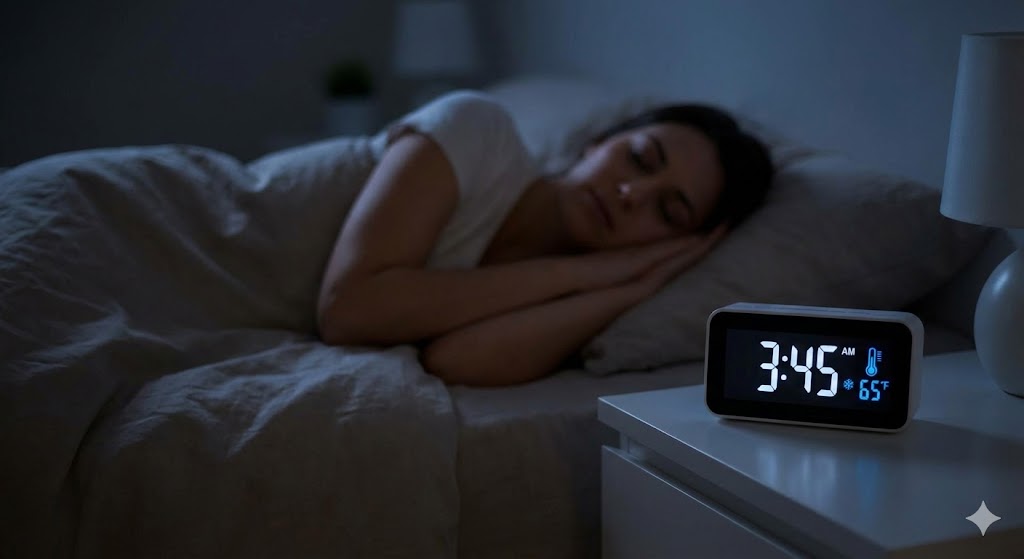
You fall asleep easily. But at 2:47 AM, your eyes snap open. Your mind starts racing. You toss and turn until your alarm goes off. This is “Sleep Maintenance Insomnia,” and it is torture. It turns your bed into a battleground.
Most people treat this by taking more Melatonin. This is a mistake. Melatonin is a hormone that signals “onset” (falling asleep). It does not govern “maintenance” (staying asleep). Waking up in the middle of the night is rarely a melatonin problem. It is usually a metabolic problem.
Biochemically speaking, your body is waking you up for a reason. Usually, it is a drop in blood sugar or a spike in core temperature. The data indicates that learning how to stay asleep all night naturally requires stabilizing your glucose and lowering your thermal set point.
Stabilizing Nocturnal Glucose For Deep Sleep Maintenance
Your brain demands fuel even while you sleep. If your blood sugar drops too low during the night (nocturnal hypoglycemia), your brain panics. It signals the adrenal glands to release Cortisol and Adrenaline. These are stress hormones. They stimulate the liver to release stored glucose. They also wake you up immediately.
According to research published by the National Institutes of Health (NIH), stabilizing nocturnal glucose levels can significantly reduce night wakings. You are not waking up because you are anxious. You are anxious because you woke up in a chemical “fight or flight” state driven by hunger.
Benchmarking the solutions shows a clear divide. Sedatives force the brain to shut down despite the stress signal. Metabolic stabilizers prevent the stress signal from firing in the first place. One masks the symptom. The other fixes the fuel supply.
| Feature | Metabolic Stabilizers (e.g., Raw Honey/Fat) | Standard Sedatives (e.g., Melatonin) |
|---|---|---|
| Primary Mechanism | Prevents hypoglycemic cortisol spikes. | Signals circadian darkness. |
| Direct Benefit | Sustains sleep through the 3 AM window. | Helps you fall asleep faster. |
| The Practical Catch | Requires calorie intake before bed. | Short half-life; wears off in 4 hours. |
5 Proven Clinical Methods For Uninterrupted Sleep
1. The “Glycine” Core Cool-Down
Your body temp must drop to stay asleep. Glycine is an amino acid that increases blood flow to the extremities. This vents heat away from the core. Clinical trials show 3 grams of Glycine before bed improves sleep efficacy and reduces fragmentation.
Pro-Tip: It tastes sweet like sugar. Mix 3g into chamomile tea.
2. The “Pre-Sleep” Fat Snack
To stop the glucose crash, eat a small amount of fat or slow carbs 30 minutes before bed. A teaspoon of raw honey or almond butter provides a steady fuel source for the liver glycogen. This prevents the adrenal panic at 3 AM.
Pro-Tip: Keep it under 100 calories to avoid digestion keeping you awake.
3. Magnesium Glycinate Loading
Magnesium regulates the neurotransmitter GABA. GABA is the “brakes” of the brain. Without enough magnesium, your brain cannot stay in “park.” Magnesium Glycinate is the most absorbable form for sleep anxiety and muscle relaxation.
Pro-Tip: Take 400mg one hour before sleep.
4. The “Sunset” Lighting Rule
Blue light suppresses melatonin. But “bright” light of any color keeps you alert. You must dim the lights to 50% brightness after sunset. This signals the brain to transition into maintenance mode. Use amber bulbs in bedside lamps.
Pro-Tip: Install f.lux or “Night Shift” on all screens to automatically warm the color temp.
5. Temperature Control
The ideal sleeping temperature is between 60°F and 67°F (15°C – 19°C). If your room is warmer than 70°F, your body struggles to release heat. This triggers a “micro-arousal” where you wake up just enough to kick off the covers.
Pro-Tip: Use breathable cotton or bamboo sheets, not synthetic polyester.
Stacking Your Strategy For Sleep Architecture
To make this work 20% better, stack your Magnesium Glycinate with L-Theanine. Do not rely on one molecule.
Magnesium relaxes the body (muscles/nerves). L-Theanine relaxes the mind (Alpha waves). L-Theanine is unique because it increases Alpha brain waves, which are associated with “relaxed wakefulness” and the transition into sleep. By combining the physical relaxation of Magnesium with the mental quiet of Theanine, you build a fortress around your sleep cycle that is harder for stress to penetrate.
Safety & Precautions
1. Kidney Function
Magnesium is cleared by the kidneys. If you have Chronic Kidney Disease (CKD), your body cannot filter excess magnesium.
Safety Note: Consult a nephrologist before supplementing.
2. Blood Pressure
Glycine and Magnesium can naturally lower blood pressure. If you are on hypotensive medication, you might get dizzy standing up at night.
Caution: Move slowly if you need to use the bathroom.
3. The “Hangover” Effect
Some people metabolize Glycine slowly. This can lead to morning grogginess.
Heads Up: Start with 1 gram and titrate up to 3 grams.
4. Digestive Distress
Magnesium draws water into the bowel. Too much can cause loose stools.
Doctor’s Note: Glycinate is the least likely to do this, but Citrate will definitely cause it.
5. Interactions
L-Theanine interacts with stimulant medications. It can blunt their effect.
Warning: Separate dosing by at least 6 hours.
5 Common Myths vs. Facts
Myth 1: Melatonin keeps you asleep.
Fact: Melatonin has a half-life of 20-50 minutes. It helps you open the door to sleep, but it leaves the building shortly after.
Myth 2: Alcohol is a nightcap.
Fact: Alcohol is a sedative, then a stimulant. As it metabolizes, it creates a “glutamate rebound” that wakes you up 4 hours later. It destroys REM sleep.
Myth 3: You need 8 continuous hours.
Fact: Sleep happens in 90-minute cycles. Waking up briefly between cycles is normal. The problem is the inability to fall back asleep.
Myth 4: Warm milk works because of Tryptophan.
Fact: The amount of Tryptophan in milk is negligible. It works because it provides calories (glucose/fat) that stabilize blood sugar.
Myth 5: You can catch up on weekends.
Fact: You cannot “bank” sleep. Consistent wake times regulate the circadian clock better than binge sleeping.
The Bottom Line
Sleep is a fragile biochemical state.
Based on the research, I believe that for the Skeptical Optimizer, the priority is Metabolic Stabilization. You cannot stay asleep if your brain is starving or overheating. Magnesium Glycinate combined with a small Fat/Protein Snack before bed addresses the two most common causes of the 3 AM wake-up call.
The practical catch is the lifestyle change. You must stop drinking alcohol and start regulating your evening light. For a clinical-strength result that keeps you under until morning, I recommend pivoting to a 3g Glycine + 400mg Magnesium stack. This lowers your core temperature and quiets the nervous system, allowing your body to complete its restoration cycles naturally.
Get Your FREE Ultimate Vitamin Guide!
Join the VitaminProGuide community to receive science-backed supplement reviews, nutritional insights, and absorption tips, delivered straight to your inbox.