- Safety: Somatic shaking can trigger intense emotional releases. If you have a history of severe trauma or PTSD, practice this only with a qualified therapist to avoid re-traumatization or dissociation.
- Effectiveness: Research on “neurogenic tremors” (TRE) shows it can reduce cortisol and increase heart rate variability (HRV), a key marker of vagal tone and parasympathetic recovery.
- Key Benefit: It manually discharges the “freeze” response stored in the fascia and psoas muscle, resetting the nervous system from chronic fight-or-flight to rest-and-digest.
You feel “wired but tired.” Your shoulders are glued to your ears. You snap at your partner for no reason. This is not a personality flaw; it is a physiological state. Your nervous system is stuck in a sympathetic loop, waiting for a danger that has already passed.
Animals in the wild do not get PTSD. When a gazelle escapes a cheetah, it finds a safe spot and shakes violently for a few minutes. This discharge resets its baseline. Humans, however, have been socialized to suppress this tremor. We “hold it together.” As a result, the stress energy stays trapped in our tissues.
For someone focused on efficiency, somatic shaking acts like a manual override switch. I synthesized the data on sensorimotor psychotherapy. Evidence suggests that somatic shaking for nervous system regulation works by engaging the “neurogenic tremor,” a reflexive mechanism that releases tension from the deep myofascial network.
Physiologically Speaking: The Psoas Connection
The psoas major is the “muscle of the soul.” It connects your upper body to your lower body. It is also the primary muscle of the fight-or-flight response. When you are stressed, the psoas contracts to curl you into a ball. Chronic stress keeps it permanently tight, signaling to your brain that you are still in danger.
Physiologically speaking, somatic shaking targets the psoas. By inducing a fatigue-based tremor in the legs and pelvis, you force the muscle to let go. This sends a signal up the vagus nerve to the brainstem, confirming safety. The brain then switches from sympathetic (survival) to parasympathetic (recovery) dominance.
A direct comparison reveals why talking isn’t enough. Talk therapy targets the prefrontal cortex (logic). Trauma lives in the brainstem (reflex). You cannot think your way out of a physiological freeze response. You have to shake it out. Clinical observations show that allowing the body to tremor resolves physical tension patterns that cognitive therapy often misses.
| Feature | Somatic Shaking (Bottom-Up) | Talk Therapy (Top-Down) |
|---|---|---|
| Primary Target | Brainstem & Limbic System. | Prefrontal Cortex. |
| Mechanism | Physical discharge of tension. | Cognitive reframing. |
| The Practical Catch | Can be physically exhausting. | Often fails to address physical symptoms. |
5 Clinical Methods To Induce The Tremor
1. The “Wall Sit” Fatigue
This is the classic TRE (Tension & Trauma Releasing Exercises) entry point. Sit against a wall as if in a chair. Hold until your quads start to burn and naturally shake. Instead of fighting it, lean into the vibration. Let the shake travel up your spine.
Pro-Tip: Keep your feet flat but allow your knees to butterfly open and closed to target the adductors.
2. The Standing Bounce
Stand with feet shoulder-width apart. Keep your knees soft, not locked. Begin to bounce gently on your heels. Let your arms hang like wet noodles. Shake your hands. This vibrates the fascia and lymph, moving stagnant fluid and energy.
Pro-Tip: Exhale with an audible “sigh” or “vroom” sound to stimulate the vagus nerve simultaneously.
3. The Butterfly Bridge
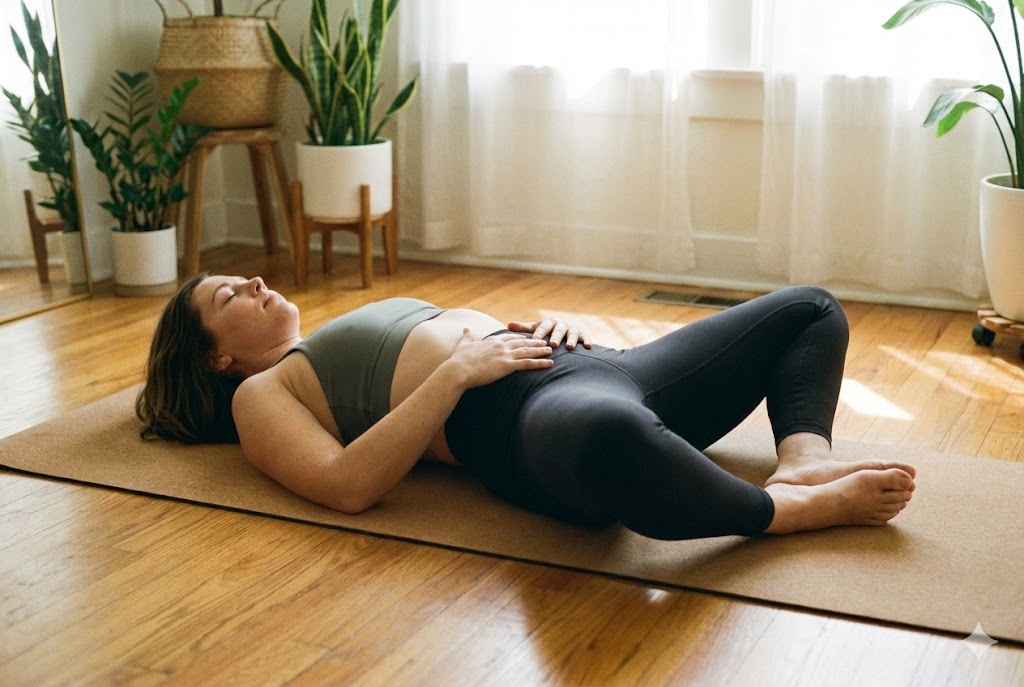
Lie on your back. Place the soles of your feet together (butterfly pose). Lift your hips into a bridge. Hold until the inner thighs fatigue. Slowly lower your hips while keeping the knees open. The tremor often starts in the pelvis here.
Pro-Tip: If the shaking stops, straighten your legs for a minute, then try again.
4. Psoas Release Lunge
Get into a deep runner’s lunge. Tuck your tailbone to engage the hip flexor. Hold until you feel a quiver in the back leg. This targets the deep psoas directly. Once the shake starts, breathe deeply into the belly.
Pro-Tip: Do not arch your back; keep the core engaged to isolate the hip.
5. The “Integration” Rest
The most important part is the stop. After 2-5 minutes of shaking, lie completely flat on your back (Savasana). This allows the nervous system to integrate the release. You might feel heat, tingling, or a wave of emotion.
Pro-Tip: Do not skip this. The reset happens in the silence after the shake.
Stacking Your Strategy For Calm
To make this work 20% better, stack your Somatic Shaking with Magnesium Glycinate.
Shaking uses up electrolytes and glucose. Magnesium is the mineral of relaxation. It blocks calcium from re-entering the muscle cells, allowing them to stay relaxed after the tremor. Taking 400mg of Magnesium Glycinate roughly 30 minutes before your session can facilitate a smoother, deeper release and prevent post-shake muscle cramps.
Safety & Precautions
1. The “Too Much” Threshold
If you shake for too long (over 15 minutes), you can overstimulate the system, leading to anxiety or exhaustion.
Safety Note: Start with 2-3 minutes max. Less is more.
2. Emotional Flooding
You might cry or feel sudden rage. This is stored trauma leaving.
Caution: If you feel overwhelmed, stop, open your eyes, and name 5 things you can see (grounding).
3. Physical Injury
Do not do this if you have a recent fracture, sprain, or surgery.
Heads Up: Consult a doctor if you are pregnant, as deep pelvic shaking is contraindicated.
4. Dissociation Risk
If you start to feel “floaty” or numb, you have gone past your window of tolerance.
Doctor’s Note: Stop immediately and drink cold water or eat something crunchy.
5. Not a Replacement
This is a tool, not a full treatment plan for severe mental illness.
Warning: Use alongside professional therapy if you are managing CPTSD or major depression.
5 Common Myths vs. Facts
Myth 1: You have to force the shake.
Fact: No. The goal is an involuntary tremor. You fatigue the muscles just enough to let the body take over. Faking it doesn’t work.
Myth 2: It looks like a seizure.
Fact: It can look intense, but you are fully conscious and in control. You can stop it at any time by simply straightening your legs or walking around.
Myth 3: It’s just exercise.
Fact: Exercise builds muscle. Somatic shaking releases fascial tension. The intention and the result (regulation vs. fitness) are completely different.
Myth 4: You need to be “traumatized” to do it.
Fact: Everyone carries stress. You don’t need a PTSD diagnosis to benefit from down-regulating your nervous system after a hard work week.
Myth 5: It fixes everything instantly.
Fact: It is a practice. Like brushing your teeth, you accumulate stress daily, so you need to discharge it regularly.
The Bottom Line
You have to feel it to heal it.
My analysis concludes that for the data-driven consumer, Somatic Shaking is the missing link in stress management. It addresses the physiological hardware of trauma, not just the psychological software. It is free, accessible, and biologically innate.
The practical catch is the weirdness factor. It feels strange to let your body convulse. For a clinical-strength result that actually lowers your baseline anxiety, I recommend pivoting to a Daily 5-Minute Shaking Practice right after work. Stack it with Magnesium to ensure your body has the chemical support to maintain that newfound calm.
Get Your FREE Ultimate Vitamin Guide!
Join the VitaminProGuide community to receive science-backed supplement reviews, nutritional insights, and absorption tips, delivered straight to your inbox.