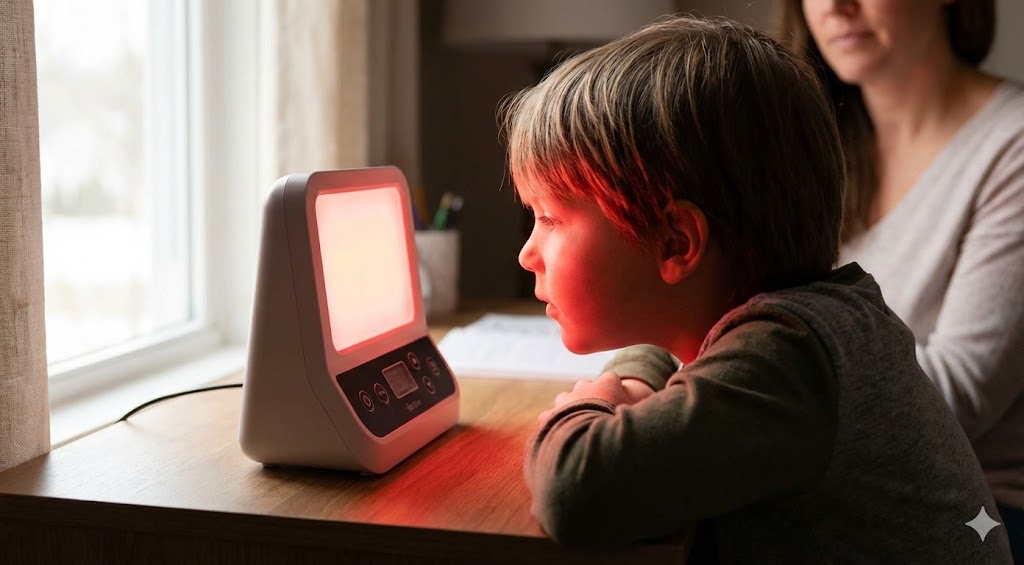
- Safety: Do not stare directly into standard LED panels meant for skin. The eyes require a specific low-intensity dosage (typically 650nm at under 50mW/cm²) to avoid thermal damage to the retina.
- Effectiveness: A 2022 multi-center clinical trial showed that repeated low-level red-light therapy (RLRL) reduced myopia progression by up to 69.4% in children compared to a control group.
- Key Benefit: It thickens the choroid (the vascular layer of the eye), which improves blood flow and prevents the eyeball from elongating further, the primary cause of worsening nearsightedness.
Your child brings home a note from the school nurse. They can’t see the board. You get them glasses, but every year the prescription gets stronger. The eyeball is stretching longer and longer like a balloon. This is progressive myopia, and it increases the risk of retinal detachment later in life.
Most treatments are passive: stronger lenses or eye drops. But a new active therapy is emerging from the research labs. It uses a specific wavelength of red light to signal the eye to stop growing.
For the data-driven parent, this is not about “vision improvement” in the sense of ditching glasses tomorrow. It is about “myopia control.” I synthesized the data on photobiomodulation for ocular health. Evidence suggests that red light therapy for myopia works by manipulating the metabolism of the sclera (the white of the eye) to halt axial elongation.
Physiologically Speaking: Choroidal Thickening
The choroid is the blood vessel layer behind the retina. In myopic eyes, this layer thins out, leading to hypoxia (lack of oxygen). This hypoxic state triggers the sclera to remodel and stretch, making the eye longer and the vision blurrier.
Physiologically speaking, red light at 650nm penetrates the retina and stimulates the mitochondria in the choroid. This increases blood flow and causes the choroid to thicken. A thicker choroid acts as a mechanical buffer, pushing the retina forward and signaling the sclera to stop stretching.
Evaluating the mechanics reveals why outdoor time is protective. Sunlight contains red/NIR wavelengths. Indoor lighting does not. Red light therapy effectively supplements the “nutrients” of natural light that modern children are missing. A study in Ophthalmology confirmed that just 3 minutes of exposure twice daily significantly retarded axial elongation.
| Feature | Red Light Therapy (RLRL) | Atropine Drops (Standard Care) |
|---|---|---|
| Mechanism | Metabolic (Choroidal thickening). | Chemical (Receptor blockade). |
| Side Effects | Temporary afterimage (rare). | Light sensitivity, blurred near vision. |
| The Practical Catch | Requires a specialized device. | Daily drops for years; rebound effect. |
5 Clinical Methods To Protect Developing Eyes
1. The “Eyerising” Device Standard
Do not buy a generic red light panel from Amazon for this. The clinical trials used a specific device (like the Eyerising Myopia Management Device) that delivers exactly 650nm light directly into the pupil at a controlled intensity. Diffuse skin panels do not provide the focused energy required for the retina.
Pro-Tip: This is a prescription-level intervention in many countries; consult an ophthalmologist.
2. The 3-Minute Protocol
The effective dose is incredibly short. The standard protocol is 3 minutes per session, twice a day, with a minimum 4-hour gap between sessions. “More” is not better. Overexposure can lead to thermal toxicity.
Pro-Tip: Use a timer. Do not guess.
3. Outdoor Light Stacking
Red light therapy mimics the outdoors, but nothing beats the real thing. Aim for 2 hours of outdoor time daily. The high intensity of natural daylight (10,000+ lux) triggers dopamine release in the retina, which inhibits eye growth.
Pro-Tip: “Outdoor time” counts even in the shade; it’s about the brightness, not direct UV.
4. The 20-20-20 Rule
Near-work (screens, books) causes hyperopic defocus, which drives eye growth. Every 20 minutes, look at something 20 feet away for 20 seconds. This relaxes the ciliary muscle and breaks the strain cycle.
Pro-Tip: Set a physical timer across the room so you have to look up to reset it.
5. Monitor Axial Length
Refraction (the glasses prescription) can fluctuate. Axial length (the length of the eyeball) is the true metric of progression. Ask your eye doctor to measure axial length every 6 months to verify if the therapy is actually halting the elongation.
Pro-Tip: If axial length grows more than 0.1mm in 6 months, you may need to stack therapies.
Stacking Your Strategy For Myopia Control
To make this work 20% better, stack your Red Light Therapy with Lutein and Zeaxanthin.
While red light stimulates the choroid, carotenoids protect the macula. Lutein acts as “internal sunglasses,” filtering out high-energy blue light that can cause oxidative stress in the retina. By combining the metabolic boost of red light with the protective shielding of Lutein, you create a robust environment for ocular health.
Safety & Precautions
1. Device Certification
The device must be Class 1 laser or LED certified for ocular use.
Safety Note: Never use a laser pointer or non-medical laser; this causes instant blindness.
2. Afterimage Duration
It is normal to see a pink/green afterimage for 1-2 minutes.
Caution: If the afterimage lasts longer than 5 minutes, the intensity is too high. Stop immediately.
3. Photosensitivity
Some medications (like tetracycline antibiotics) make eyes sensitive to light.
Heads Up: Check drug interactions before starting light therapy.
4. Not for Adults
This therapy is primarily for progressive myopia in children (ages 3-16).
Doctor’s Note: It will not reverse existing myopia in adults whose eyes have stopped growing.
5. Retinal Disease
Contraindicated for anyone with existing retinal pathology.
Warning: A full dilated eye exam is mandatory before starting.
5 Common Myths vs. Facts
Myth 1: It cures nearsightedness.
Fact: It does not reverse it. It slows the progression. A -3.00 child will likely stay -3.00 instead of progressing to -6.00.
Myth 2: Red light glasses work.
Fact: Simply wearing red-tinted lenses does not deliver the specific wavelength energy needed to thicken the choroid.
Myth 3: Screen time causes all myopia.
Fact: It is a factor, but lack of outdoor light is a bigger one. Indoor kids get myopia even if they read books instead of iPads.
Myth 4: It’s dangerous radiation.
Fact: It is visible red light, not UV or X-ray. At controlled doses, it is bio-stimulatory, not destructive.
Myth 5: Eye exercises (Bates Method) work better.
Fact: Eye rolling does not change the shape of the eyeball. Red light therapy has randomized clinical trials (RCTs) backing its structural impact.
The Bottom Line
Stop the stretch before it’s permanent.
My analysis concludes that for the efficiency-minded parent, Repeated Low-Level Red-Light Therapy (RLRL) is the most promising non-invasive tool for myopia control available today. It addresses the root cause—choroidal thinning—rather than just correcting the symptom with lenses.
The real challenge lies in the hardware. You cannot DIY this with a heat lamp. For a clinical-strength result that saves your child’s future vision, I recommend pivoting to a Medically Prescribed RLRL Device used under ophthalmologist supervision. Stack it with 2 Hours of Outdoor Time to provide the dopamine signal needed to keep the eye shape stable.
Get Your FREE Ultimate Vitamin Guide!
Join the VitaminProGuide community to receive science-backed supplement reviews, nutritional insights, and absorption tips, delivered straight to your inbox.