Contents
- Safety: Painless popping is usually harmless. However, if the click is accompanied by pain, swelling, or the knee “locking” (getting stuck), you likely have a meniscus tear or cartilage defect. See an orthopedist immediately.
- Effectiveness: Research indicates that strengthening the Vastus Medialis (VMO) muscle corrects patellar tracking issues, silencing the “mechanical” clicking caused by the kneecap rubbing against the thigh bone.
- Key Benefit: Improving joint lubrication and alignment reduces the friction that leads to long-term wear and tear (osteoarthritis).
You squat to grab something. Snap. It’s like a dry twig breaking. You head up the stairs. Crunch. It feels like gravel grinding in your joint. Your knees are making noise, and you can’t help but worry they’re wearing out.
Medical professionals call this “crepitus.” It is the sound of friction or gas release. While often dismissed as “normal aging,” it is a signal that your joint mechanics are sloppy. Your kneecap is not gliding; it is grinding. Ignoring it is a gamble with your mobility.
I looked into the biomechanics of the patellofemoral joint, and the evidence shows that stopping knees from clicking and popping means tackling two main issues: not enough synovial lubrication (the oil) and a misaligned tracking mechanism (the gears).
Physiologically Speaking: The Tracking Error
The kneecap (patella) is supposed to slide smoothly in a groove on your femur. It is held in place by muscles. If the outer muscle (IT Band/Vastus Lateralis) is tight and the inner muscle (VMO) is weak, the kneecap gets pulled sideways. It jumps out of the track. Click.
Physiologically speaking, another cause is “cavitation.” This is the popping of nitrogen bubbles in the synovial fluid. It is harmless, like cracking knuckles. However, the “sandpaper” grinding sound is Chondromalacia Patellae. This is the softening of the cartilage. The smooth coating is gone. Bone is rubbing on rough cartilage.
A direct comparison reveals the urgency. Bubble popping is intermittent and loud. Tracking issues are repetitive and happen at the exact same angle every time. A study by the American Academy of Orthopaedic Surgeons highlights that correcting patellar tracking can significantly reduce the risk of developing patellofemoral pain syndrome.
| Feature | Cavitation (Gas Bubbles) | Mechanical Crepitus (Friction) |
|---|---|---|
| Sound | Loud, singular “Pop”. | Grinding, crunching, repetitive click. |
| Cause | Pressure change in fluid. | Cartilage wear or poor tracking. |
| The Practical Catch | Harmless; hard to stop. | Indicates wear; treatable. |
5 Clinical Methods To Silence The Joint
1. Wake Up The VMO
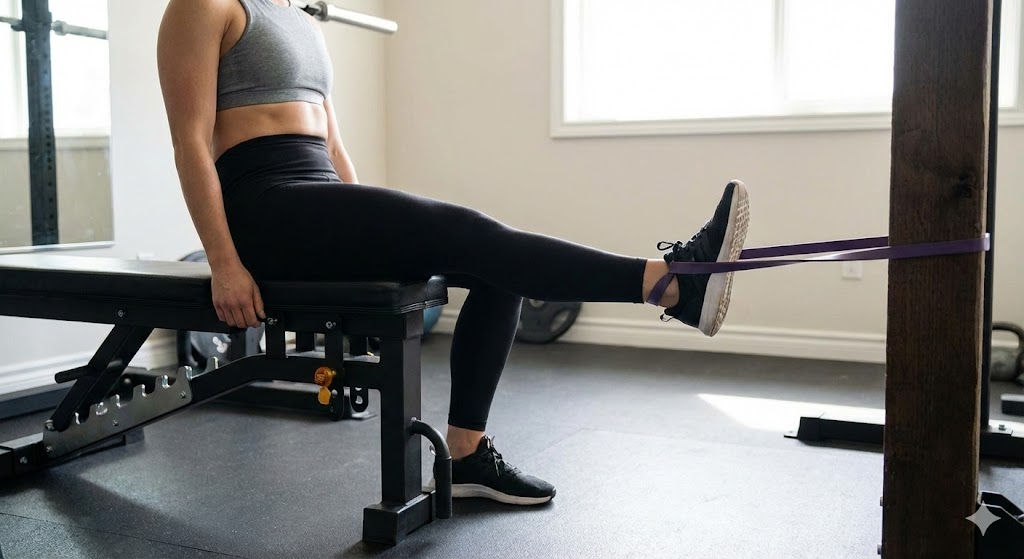
The Vastus Medialis Oblique (VMO) is the teardrop muscle on the inside of your knee. It is the primary stabilizer. Most people have “sleepy” VMOs. Perform “Terminal Knee Extensions” (TKEs) using a resistance band. Straighten the knee fully against resistance to force this muscle to fire and pull the kneecap back into its groove.
Pro-Tip: Do 20 reps before any leg workout to prime the tracking.
2. Hyaluronic Acid Loading
Synovial fluid is your joint oil. Its main component is Hyaluronic Acid (HA). As we age, we produce less. Oral HA supplements (high molecular weight) have been shown to migrate to connective tissue, improving viscosity. It makes the fluid slicker, reducing the noise.
Pro-Tip: Liquid formulations often have better absorption than pills.
3. Release The IT Band
A tight Iliotibial (IT) Band pulls the kneecap outward. You cannot stretch the IT band (it is like steel cable), but you can release the muscle attached to it (Tensor Fasciae Latae). Use a foam roller or lacrosse ball on the hip muscle, not the band itself, to slacken the tension line.
Pro-Tip: Rolling the side of the leg is painful and ineffective; focus on the muscle at the top of the hip.
4. Glucosamine Sulfate
Cartilage is like a sponge. It needs water to stay plump. Glucosamine helps maintain the water content in the cartilage matrix. If the sponge dries out, it gets hard and noisy. Sulfate forms are superior to HCL forms for bioavailability.
Pro-Tip: It takes 4-8 weeks to saturate the tissue; do not expect instant silence.
5. “Motion is Lotion” Protocol
Cartilage has no blood supply. It gets nutrients only through compression and decompression (movement). Stationary biking with low resistance cycles the fluid through the joint, nourishing the cartilage without heavy impact. Sedentary knees are noisy knees.
Pro-Tip: 10 minutes of spinning daily is enough to lubricate the joint capsule.
Stacking Your Strategy For Lubrication
To make this work 20% better, stack your Collagen Peptides with Vitamin C.
Collagen provides the amino acids (glycine, proline). Vitamin C is the essential cofactor required to weave those amino acids into new cartilage tissue. Without Vitamin C, collagen supplementation is metabolically useless for repair. Take 10-20g of hydrolyzed collagen with 500mg of Vitamin C roughly an hour before your rehab exercises to drive the nutrients into the tendons.
Safety & Precautions
1. Meniscus Tear Signs
If the knee “catches” or you cannot fully straighten it, this is a mechanical block.
Safety Note: Do not force it straight. You could tear the cartilage further. See a doctor.
2. Squat Depth
Deep squats are safe for healthy knees but can aggravate tracking issues.
Caution: Limit range of motion to 90 degrees until the VMO is strong enough to control the turn.
3. Shellfish Allergy
Most Glucosamine is made from shellfish shells.
Heads Up: Look for “vegan” glucosamine (made from corn) if you are allergic.
4. Injection Risks
Hyaluronic acid injections (viscosupplementation) carry a risk of infection.
Doctor’s Note: Try oral supplements and rehab for 3 months before considering needles.
5. Ignore The Pain Rule
“No pain, no gain” destroys knees.
Warning: If an exercise causes clicking and pain, stop immediately. You are grinding bone.
5 Common Myths vs. Facts
Myth 1: Cracking your knuckles causes arthritis.
Fact: It does not. Studies show habitual knuckle crackers have no higher rate of arthritis. The same applies to painless knee popping (cavitation).
Myth 2: Running ruins your knees.
Fact: Recreational running actually protects knees by thickening the cartilage. Only elite, high-volume running or running with poor mechanics is linked to damage.
Myth 3: You should stop moving if it clicks.
Fact: Stopping movement dries out the joint (atrophy). You need modified, low-load movement to keep the fluid circulating.
Myth 4: Surgery fixes the noise.
Fact: Arthroscopy (“cleaning out the knee”) often fails to stop the noise and can accelerate arthritis. It is not a cosmetic procedure for sound.
Myth 5: Collagen regrows cartilage.
Fact: It supports the existing matrix and reduces inflammation, but it cannot regrow a completely worn-away meniscus. It is maintenance, not magic.
The Bottom Line
Align the gears, grease the machine.
My analysis concludes that for the efficiency-minded user, Noisy Knees are a cry for biomechanical help. The noise is the symptom; the weak VMO and dry cartilage are the disease.
The real test is sticking to discipline. TKEs are boring. For a clinical-strength result that makes your knees stealthy again, I recommend pivoting to a daily regimen of VMO Activation Exercises combined with 1,500mg Glucosamine Sulfate. Stack it with Oral Hyaluronic Acid to restore the viscosity of your synovial fluid, and stop the grind before it becomes a surgery.
Get Your FREE Ultimate Vitamin Guide!
Join the VitaminProGuide community to receive science-backed supplement reviews, nutritional insights, and absorption tips, delivered straight to your inbox.