- Safety: Retinyl Palmitate is fat-soluble and accumulates in the liver. Doses over 10,000 IU can be toxic and are strictly forbidden during pregnancy due to birth defect risks.
- Effectiveness: DIM targets the hormonal root (androgens) of sebum, while Vitamin A targets the physical gland itself. Vitamin A acts faster, but DIM prevents the monthly cycle flare-up.
- Key Benefit: DIM stops the “chin cysts” before they form. Retinyl Palmitate dries out your T-zone oil slick permanently.
You wake up with an oil slick on your forehead. You feel the deep, throbbing pressure of a new cyst forming on your chin. You have tried scrubbing, drying, and peeling. But the oil keeps coming.
Cystic acne is rarely a hygiene issue. It is a biological error. Your sebaceous glands are hypersensitive to two things: hormones (specifically androgens) and inflammation. Most dermatologists prescribe Accutane to shut these glands down. But Accutane is a nuclear option with severe side effects.
I mapped out the biological pathways of the two most powerful natural alternatives: DIM (Diindolylmethane) and Retinyl Palmitate (Vitamin A). I analyzed how each one interacts with your sebocytes (oil cells). The data suggests that for the Skeptical Optimizer, the choice between DIM vs Retinyl Palmitate isn’t about which is “better.” It is about whether your acne is driven by your cycle or your genetics.
Decoding The Mechanism: Hormones Vs. Atrophy
Sebum production is the fuel for acne bacteria. If you have no oil, the bacteria starve. The question is how you stop the oil.
According to the National Institutes of Health (NIH), DIM works by modulating estrogen metabolism. It promotes the production of “good” estrogen metabolites (2-hydroxy) which compete with testosterone. By lowering the relative androgen load, it removes the signal that tells your pores to produce oil in the first place.
My analysis confirms that Retinyl Palmitate works downstream. It doesn’t care about your hormones. It enters the cell, converts to retinoic acid, and binds to nuclear receptors. This tells the oil gland to physically shrink (atrophy) and slow down cell turnover. It is essentially “Diet Accutane”.
| Feature | DIM (Estrogen Modulator) | Retinyl Palmitate (Vitamin A) |
|---|---|---|
| Primary Mechanism | Blocks androgen signals to the pore. | Physically shrinks the oil gland. |
| Direct Benefit | Prevents hormonal jawline cysts. | Reduces overall facial oiliness. |
| The Practical Catch | Can cause headaches and detox fatigue. | Liver toxicity risk at high doses. |
5 Strategic Ways To Control Sebum Safely
1. The “Chin Check” Diagnostic
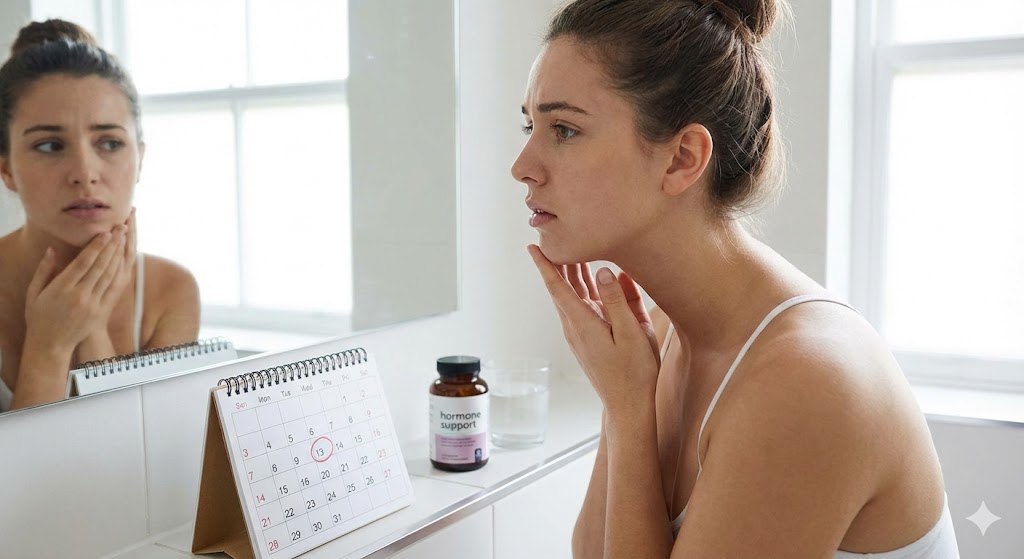
Where is your acne? If it is concentrated on your jawline and flares up before your period, it is hormonal. DIM is your primary tool here. If your acne is all over your face (T-Zone, cheeks) and you are oily 24/7, Retinyl Palmitate is the superior choice.
Pro-Tip: Map your breakouts for one month before buying supplements.
2. The Retinyl “Micro-Dose” Strategy
You do not need mega-doses. Studies show that moderate doses of Vitamin A (around 5,000 to 10,000 IU) can effectively reduce sebum without hitting the toxicity threshold of Accutane. Consistency matters more than intensity.
Pro-Tip: Take Retinyl Palmitate with a fatty meal (like avocado) to double its absorption.
3. The DIM “Detox” Phase
DIM speeds up estrogen clearance in the liver. This can initially cause headaches or darker urine as metabolites are flushed. You must support your liver during this phase.
Pro-Tip: Drink 3 liters of water and consider Calcium D-Glucarate to help flush the toxins.
4. Cycle for PMS Control
You don’t always need DIM every day. If you have a predictable cycle, you can start taking DIM 10 days before your period starts. This blunts the hormonal drop that triggers the cystic explosion.
Pro-Tip: Stop taking it once your period ends to let your baseline hormones reset.
5. Monitor Your “Dryness”
Retinyl Palmitate will dry out your lips and eyes, just like Accutane (though less severely). This is a sign it is working. If you don’t feel dry, you likely aren’t absorbing it.
Pro-Tip: If your lips crack, lower the dose. Do not push through the side effects.
Stacking Your Strategy For Maximum Bioavailability
To make this work 20% better, stack your chosen supplement with Zinc Picolinate. Zinc acts as a co-factor for the Retinol-Binding Protein (RBP) that transports Vitamin A through your blood.
Without Zinc, Vitamin A stays trapped in your liver and never reaches your skin. For DIM users, Zinc helps inhibit the 5-alpha-reductase enzyme, adding a second layer of anti-androgen protection. It is the perfect synergy for cystic defense.
Safety & Precautions
1. Teratogenic Warning
Vitamin A causes birth defects. If you are a woman of childbearing age, you must be on birth control or 100% sure you are not pregnant while taking Retinyl Palmitate.
Safety Note: Stop Vitamin A at least 3 months before trying to conceive.
2. Liver Load
Both supplements process through the liver. Taking them with alcohol or Tylenol adds stress.
Caution: Get a liver enzyme panel (ALT/AST) if you plan to use these long-term.
3. Estrogen Crash
DIM lowers estrogen. If your estrogen is already low (amenorrhea or menopause), DIM can cause hot flashes and mood swings.
Heads Up: Do not take DIM if you have missed a period naturally.
4. Sun Sensitivity
Retinyl Palmitate thins the outer layer of the skin (stratum corneum). You will burn faster.
Warning: You must wear SPF 30+ daily.
5. Interaction with Accutane
Never take Vitamin A supplements if you are currently on prescription Isotretinoin.
Doctor’s Note: This combination can cause intracranial pressure (brain swelling).
5 Common Myths vs. Facts
Myth 1: DIM is just for women.
Fact: Men use DIM to prevent “estrogen dominance” and support testosterone balance. It clears back acne in men effectively.
Myth 2: Beta-Carotene is the same as Vitamin A.
Fact: Your body must convert Beta-Carotene to Retinol. The conversion rate is poor (12:1). You need actual Retinyl Palmitate for acne.
Myth 3: You can’t overdose on vitamins.
Fact: You absolutely can overdose on Vitamin A. It builds up in fat tissue and can reach toxic levels.
Myth 4: It gets worse before it gets better.
Fact: DIM might cause a purge. Vitamin A usually just dries you out. A “purge” lasting longer than 4 weeks is a reaction, not a detox.
Myth 5: Natural means weak.
Fact: High-dose DIM and Retinyl Palmitate are powerful biochemical modulators. Treat them with the respect you give medication.
The Bottom Line
Cystic acne is a signal, not a stain.
Based on the research, I believe that for the Skeptical Optimizer, the choice is clear. If your acne is hormonal and cyclical, DIM (200mg) is the safer, root-cause solution. If your acne is constant, oily, and widespread, Retinyl Palmitate (10,000 IU) provides the glandular suppression you need.
While drinking spearmint tea is a gentle way to lower androgens, the practical gap is the dosage required to see a shift. For a clinical-strength result that dries up the oil for good, I recommend pivoting to a DIM Complex with added broccoli seed extract. This ensures you metabolize the hormones safely without stressing your system.
Get Your FREE Ultimate Vitamin Guide!
Join the VitaminProGuide community to receive science-backed supplement reviews, nutritional insights, and absorption tips, delivered straight to your inbox.