- Safety: Astaxanthin is a potent carotenoid pigment. High doses (above 48mg/day) can temporarily turn stool red or give skin a slight orange tint. Always ensure the source is Haematococcus pluvialis algae, not petrochemicals.
- Effectiveness: Clinical data indicates that Astaxanthin is 6,000 times more potent than Vitamin C at quenching singlet oxygen, significantly reducing the oxidative stress that degrades the vitreous humor.
- Key Benefit: Unlike generic antioxidants, it crosses the blood-retina barrier to stabilize the vitreous gel and prevent new collagen clumps (floaters) from forming.
You swat at a gnat that isn’t there. You try to read a white page, but a grey cobweb drifts across the text. Eye floaters are technically “vitreous opacities”, microscopic clumps of collagen fibers casting shadows on your retina. They are often dismissed as a harmless annoyance of aging. But to the Skeptical Optimizer, they are a biological signal that the gel inside your eye is oxidizing.
Standard advice suggests “ignoring them” or risking invasive surgery. But ignoring oxidative degradation is not a strategy. You need a molecule capable of penetrating the eye’s defensive wall to neutralize the free radicals causing the collagen to clump. Most antioxidants fail here. They are either too weak or unable to cross the Blood-Retina Barrier (BRB).
Scanning the biochemical landscape reveals a clear winner. Beta-carotene (carrots) and Vitamin E settle in cell membranes but lack the transmembrane structure to fully protect the eye. Astaxanthin, however, spans the entire cell membrane, acting as a molecular rivet. The data suggests that for the best astaxanthin supplement for eye floaters, the difference between a maintenance dose and a therapeutic dose is massive.
Targeting Retinal Oxidation With Carotenoids
The eye has the highest metabolic rate of any organ, producing massive amounts of oxidative waste. This waste degrades the vitreous humor, turning it from a clear gel into a watery liquid with stringy debris. To stop this, you need an antioxidant that can physically reach the interior of the eye.
According to a review published by the National Institutes of Health (NIH), Astaxanthin is 6,000 times more potent than Vitamin C and 550 times stronger than Vitamin E at quenching singlet oxygen. It effectively armors the eye against the UV and blue light radiation that breaks down vitreous collagen. It is the “King of Carotenoids” for a reason.
Unlike competitors that rely on surface-level protection, Astaxanthin accumulates in the ciliary body and the retina. It improves capillary blood flow to the optic nerve. While Lutein protects the macula (central vision), Astaxanthin protects the entire front-to-back structure, stabilizing the gel against further collapse.
| Feature | Natural Astaxanthin (12mg) | Lutein / Zeaxanthin |
|---|---|---|
| Primary Mechanism | Crosses Blood-Retina Barrier; spans cell membrane. | Filters blue light in the macula. |
| Direct Benefit | Reduces vitreous oxidation and eye strain. | Protects central vision acuity. |
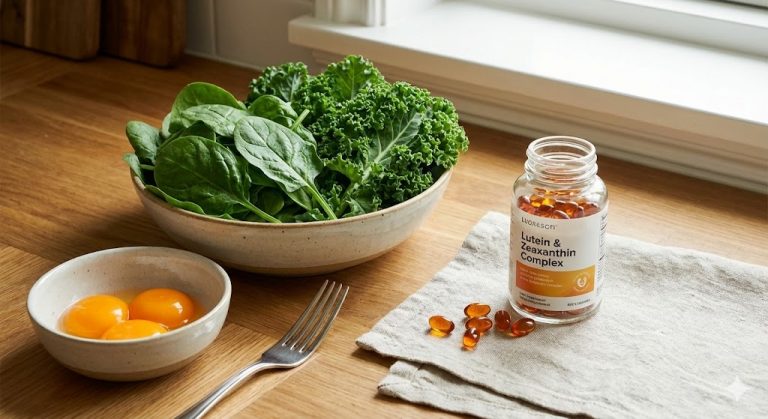
| The Practical Catch | Expensive; requires dietary fat for absorption. | Does not address the vitreous gel structure as well. |
5 Practical Real-World Methods For Visual Clarity
1. The 12mg Threshold
Most pharmacy brands sell 4mg capsules. This is a maintenance dose for skin health. For deep tissue saturation in the eye, clinical evidence supports a higher dose range of 12mg daily. You cannot get this amount from eating shrimp alone.
Pro-Tip: Look for “Natural Algae Astaxanthin” on the label to ensure potency.
2. The Fat Transporter
Astaxanthin is lipid-soluble. If you take it with black coffee, you flush 90% of it. It requires dietary fat to be emulsified and absorbed into the bloodstream. Take it with eggs, avocado, or your fish oil supplement.
Pro-Tip: The “Eye Breakfast” is 12mg Astaxanthin + 2 Eggs.
3. The Pineapple Stack
While Astaxanthin prevents new floaters, proteolytic enzymes might help break down existing ones. Bromelain (from pineapple stems) has shown promise in digesting collagen debris. Stacking Astaxanthin (protection) with Bromelain (cleanup) creates a dual-threat protocol.
Pro-Tip: Take Bromelain on an empty stomach; take Astaxanthin with food.
4. Source Verification
Synthetic Astaxanthin (made from petrochemicals) is used for fish food. It is essentially food dye. You need natural Astaxanthin derived from the microalgae Haematococcus pluvialis. The molecular structure of the natural form is far more bioavailable.
Pro-Tip: If the bottle doesn’t say “Algae” or “Pluvialis,” do not buy it.
5. Hydration Mechanics
The vitreous humor is 99% water. Dehydration causes the gel to shrink and pull away from the retina, creating more floaters. Astaxanthin helps cell membranes retain water, but you must supply the fluid.
Pro-Tip: Drink 3 liters of water daily to keep the vitreous plump.
Stacking Your Strategy For Maximum Bioavailability
To make this work 20% better, stack your Astaxanthin with Omega-3 Fish Oil (DHA). The retina has the highest concentration of DHA in the body.
The primary difference lies in the transport vehicle. Astaxanthin binds to the lipid molecules in Fish Oil, which acts as a “Trojan Horse” to carry the antioxidant through the digestive system and directly into the retinal tissue. Taking them together significantly increases the plasma concentration of Astaxanthin compared to taking it alone.
Safety & Precautions
1. Low Blood Pressure
Astaxanthin is a mild vasodilator (opens blood vessels). If you are on blood pressure medication, it could lower your levels further.
Safety Note: Monitor your BP if you feel lightheaded.
2. Hormone Interaction
High doses can slightly inhibit 5-alpha-reductase (the enzyme that converts testosterone to DHT).
Caution: Generally a positive side effect for men (prostate health), but worth noting.
3. Shellfish Allergy
Some cheap brands extract Astaxanthin from krill or shrimp shells.
Heads Up: Stick to Algae-sourced brands if you are allergic to shellfish.
4. Stool Color
At doses above 20mg, you may notice a reddish tint to your bowel movements. This is unabsorbed pigment.
Doctor’s Note: It is harmless, but reduce the dose if it persists.
5. Pregnancy
There is insufficient data on high-dose Astaxanthin during pregnancy.
Warning: Stick to dietary sources (salmon) if you are expecting.
5 Common Myths vs. Facts
Myth 1: It dissolves floaters instantly.
Fact: No supplement works instantly. It takes 3-6 months to stabilize the vitreous and prevent new clumps.
Myth 2: Krill Oil is the best source.
Fact: Krill Oil contains very little Astaxanthin (maybe 0.5mg per pill). You would need to swallow 24 pills to get a therapeutic dose.
Myth 3: Carrots are just as good.
Fact: Beta-carotene does not cross the blood-retina barrier as efficiently as Astaxanthin.
Myth 4: You can’t take too much.
Fact: While safe, massive doses are a waste of money because your body can only absorb so much lipid at once.
Myth 5: It replaces sunglasses.
Fact: It acts as an internal sunscreen, but you still need UV protection on the outside to prevent cataracts.
The Bottom Line
Floaters are a sign of structural rusting.
Based on the research, I believe that for the Skeptical Optimizer, Natural Astaxanthin (12mg) derived from algae is the best tool for protecting the vitreous humor. It stops the oxidative degradation that turns clear gel into cloudy debris. Generic 4mg doses are simply too weak to penetrate the eye in meaningful amounts.
The practical catch is that eating wild salmon every day is expensive and potentially high in mercury. For a clinical-strength result that clears the visual field, I recommend pivoting to a 12mg Algae Astaxanthin Capsule taken with a fatty meal. Stack it with Bromelain to attack the existing debris while you shield your eyes from future damage.
Get Your FREE Ultimate Vitamin Guide!
Join the VitaminProGuide community to receive science-backed supplement reviews, nutritional insights, and absorption tips, delivered straight to your inbox.